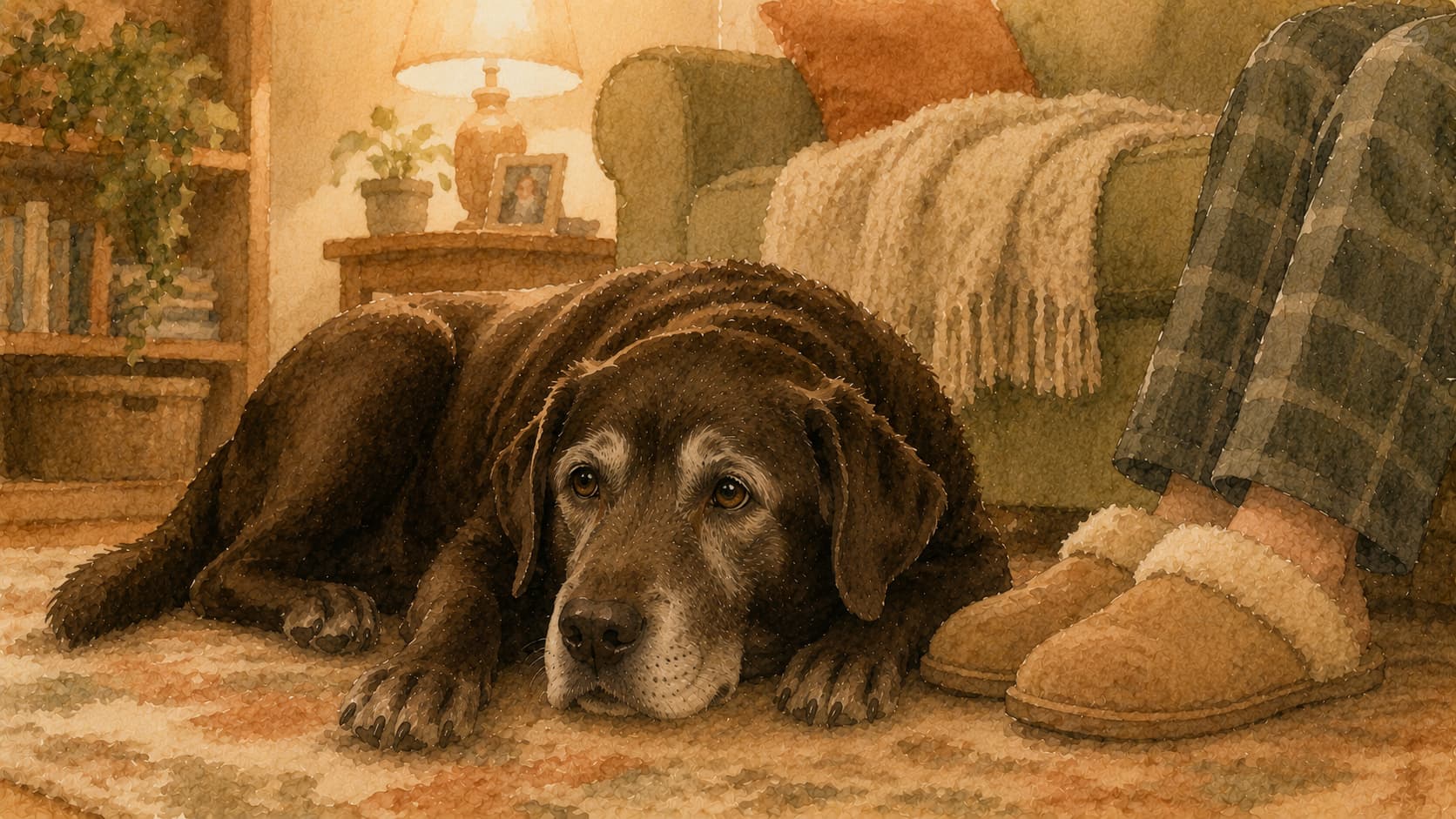
She used to be the confident one. The dog who slept through storms, who handled being alone for hours, who never paid much attention to the doorbell. Now she shadows you from room to room, pants when nothing's wrong, and trembles at sounds she's lived with for ten years. Senior dog anxiety isn't a personality change. It's a signal — almost always pointing at something underneath it.
Anxiety in a senior dog is usually a downstream signal of something else, not the underlying problem. The four most common drivers are pain (especially joint pain), canine cognitive dysfunction (CCD), sensory loss (vision or hearing), and routine disruption. Most affected dogs have two or more drivers at once. Structured observation over a week, combined with a focused vet visit, typically reveals which contributors matter most.
Most articles about senior dog anxiety jump straight to calming products and supplements. We're going to do the opposite. Anxiety in a senior dog is rarely the actual problem. It's almost always a downstream effect of something else — pain, cognitive change, sensory loss, or a routine that's drifted out of alignment. Figure out what's underneath and the anxiety often resolves on its own.
This guide walks you through the four most common drivers, how to tell them apart, and the calm evening reset that helps most senior dogs settle. We don't recommend specific medications or supplements — those are vet decisions, and the right choice depends on what's actually driving the anxiety. The home work below works alongside whatever your vet recommends.
What senior dog anxiety usually looks like
The pattern is consistent enough to be recognisable. Owners typically describe some mix of:
- Increased clinginess. Following you from room to room. Inability to settle when you're out of sight. Pawing at you when you sit down.
- Panting without obvious cause. Heavy breathing when the dog isn't hot, hasn't been active, and isn't in obvious pain.
- Trembling. Sometimes during specific situations (storms, alone time), sometimes more diffuse.
- New fears. Sounds, situations, or environments that didn't previously bother your dog. The vacuum cleaner that was never a problem. A specific room in the house. The car ride.
- Restless evenings. Pacing, vocalising, inability to settle in the hours after dinner.
- Hypervigilance. Looking around more, reactive to small sounds, lifting their head at things that wouldn't have registered before.
What makes senior-onset anxiety different from lifelong anxiety: the dog used to handle things they're now struggling with. The change itself is the signal.
What's actually driving it: four common causes
Senior dog anxiety has four typical drivers. Most dogs have two of them at once.
Pain. This is the most under-recognised cause and probably the most common. A dog with chronic joint pain, dental pain, or back pain experiences the world as a place where unexpected things hurt. Their nervous system stays on alert. Surfaces become unpredictable. Touch is something to anticipate. Clinginess and hypervigilance look like emotional anxiety but are often pain telling the body "be careful."
The test: does the anxiety pattern shift on days your dog has been less active? Does it correlate with weather changes? Has your vet specifically assessed for pain in the last year? If not, that's the first step.
Cognitive change. Canine cognitive dysfunction (CCD — full guide) is anxiety's most common confounder in senior dogs. The brain regions that handle threat assessment, novelty processing, and emotional regulation become less reliable with age. What used to be predictable feels uncertain. What used to be familiar feels new. The anxiety domain is one of the six DISHAA categories specifically because of this overlap.
Senior anxiety that started in the last 1–2 years, paired with other CCD signs (slower greetings, occasional confusion, indoor accidents, sleep–wake shifts), is often actually CCD with anxiety as one of its expressions.
Sensory loss. Vision and hearing both decline gradually in senior dogs, and both produce anxiety when the dog can no longer compensate. A dog with hearing loss can't hear you approaching — so being touched comes as a surprise. A dog with vision changes can't see clearly in low light — so dusk becomes unsettling. Sensory loss often masquerades as anxiety until you realise the dog isn't anxious; they just can't predict their environment anymore.
Routine disruption. Senior dogs become more sensitive to changes in their daily structure. A schedule shift, a household change, even a different walking route can produce days or weeks of unsettled behaviour. Younger dogs adapt; senior dogs adapt slower.
Most senior dogs have some combination of two or three of these. The work isn't isolating the cause. It's understanding which contributors are biggest so the right interventions get prioritised.
Three common anxiety patterns
Within the broader category, three patterns show up often enough to name.
Sundowning anxiety. Anxiety that's noticeably worse from late afternoon onward. The dog is fine during the day but unrecognisable by 7pm. This is the pattern most strongly linked to cognitive change. Separate guide on sundowning.
Separation sensitivity. The dog cannot be alone, even briefly, without distress. This may or may not be true "separation anxiety" in the clinical sense — in seniors, what looks like separation anxiety is often pain-driven (alone means unable to ask for help) or cognitively-driven (alone means trying to navigate without their human cues).
Sound sensitivity. Storms, fireworks, household noises that didn't previously register. This is sometimes a true sensitivity that emerges with age, sometimes a sign that hearing is changing in a way that makes sounds register differently or unexpectedly.
The pattern matters because the interventions differ. The home work below addresses all three, but knowing which pattern dominates helps you focus.
Tonight: a calm reset that works for most dogs
If you're reading this in the middle of an anxious evening, here's the actionable version.
Lower the stimulation. Dim any bright lights still on. Reduce sound — TV down, conversations softer. Close curtains if external light or activity is visible. An anxious senior nervous system has less bandwidth; reducing input is the single biggest thing you can do in the next thirty minutes.
Don't soothe actively. This is counterintuitive. The instinct when a dog is anxious is to comfort — to hold them, to talk reassuringly, to follow them around the house. Active soothing often extends anxiety in dogs by signalling that something is in fact wrong. Calm proximity works better. Sit in the room. Read a book. Let your steady, undramatic presence be part of the environment.
Offer a slow chew or scatter-fed treats. Sniffing and chewing trigger calming neurochemicals. A long-duration chew (15–30 minutes of work) can shift a dog from anxious mode into focus mode, and often into a settled state shortly after. Hidden treats around a quiet corner of the room work similarly.
Settled spot near you, but not on you. A bed within sight of where you are, but not pressed up against you. Many anxious dogs want proximity, not contact. Contact can keep the nervous system activated; proximity lets it settle.
Wait it out. Most evening anxiety episodes in senior dogs follow a curve — escalation, peak, gradual descent. Don't try to interrupt it. Let it run its arc with the conditions above in place. Most dogs settle within 60–90 minutes once the environment is right.
Free 2-minute DISHAA assessment
See where your dog stands across the six dimensions vets use to track cognitive change. Enter your email — we'll send your assessment and a 3-night calm plan.
Free · 2 minutes · no account · unsubscribe anytime.
This week: structured observation
The single most useful thing you can do this week is figure out what's driving the anxiety. That means logging:
- The time anxiety started, each day. Morning? After meals? Evenings only?
- What was happening when it started. Did someone leave? Did a sound trigger it? Was it spontaneous?
- Any physical signs that day. Stiffness, limping, slow on stairs, eating less.
- The settling time. How long did it take to resolve?
- Sleep duration overnight. Total hours of solid sleep.
After five to seven days, patterns become visible. If anxiety correlates strongly with physical signs, pain is high on the list. If it correlates with evening hours specifically, cognitive change/sundowning are high. If it correlates with being alone, separation sensitivity is high. If it correlates with sounds, sensory or sound sensitivity is high.
The free DISHAA quiz gives you another data point — a score across all six DISHAA domains including anxiety. Cognitive change as a driver shows up most clearly there.
Want a structured way to read this? Our free 12-question quiz takes two minutes and scores cognitive change across six domains, including the anxiety domain. Plus a 3-night calm plan in your inbox. Take the free quiz →
This month: addressing the underlying cause
After a week of observation, you'll have a sense of which drivers are biggest. The interventions cluster by cause.
If pain looks like a driver: schedule a vet visit specifically for pain assessment. Bring the observation log. Many senior dogs are under-treated for chronic pain, and addressing it often dissolves what looked like emotional anxiety.
If cognitive change looks like a driver: the work moves to environmental structure and routine support. Predictable evenings, consistent feeding windows, calm wind-down rituals. The full eight-week framework is the Hearthside Method; the pillar guide on cognitive change covers it broadly.
If sensory loss looks like a driver: a vet visit for a basic eye and ear exam. Nightlights in low-light areas. Approach your dog from in front rather than behind so they can see you coming. Reduce sudden sounds in the household where possible.
If routine disruption looks like a driver: stabilise. Same wake time, same meal times, same walks, same evening sequence. Senior dogs settle into rhythms more deeply than younger dogs do; rebuilding the rhythm often resolves the anxiety within two to three weeks.
When to involve your vet
Several scenarios warrant a vet visit sooner rather than later.
- Anxiety that started suddenly (days rather than weeks)
- Anxiety paired with new physical symptoms (limping, appetite change, increased water intake, weight loss)
- Trembling that doesn't resolve when the environment is calm
- Vocalising that sounds distressed (not just attention-seeking)
- Any time the anxiety interferes significantly with eating, drinking, sleeping, or basic daily function
- Anxiety in a dog who's never been anxious — that change itself is a signal
Bring observations. Three weeks of logged anxiety episodes with time, context, and physical signs gives your vet far more to work with than "she's been more anxious lately."
Your vet has options. Some involve medication, some don't, all depend on what's actually driving the anxiety. The home work above doesn't replace those options — it makes them work better.
What we don't recommend (and why)
You'll see a lot of articles confidently recommending specific calming products, supplements, or natural remedies for senior dog anxiety. We're not going to do that. There are real options in all three categories, but the right choice depends on your dog's medical context, current medications, and what's underneath the anxiety pattern. None of that information is available to us. All of it is available to your vet.
What we can tell you: there are real options. You aren't out of choices. Bring the observation log, walk through the differential with your vet, and the right next steps usually become clear.
This is one of those situations where the structure of the conversation matters more than the speed. Take the week to observe. Take the second week to make a focused vet visit. The dog you've loved your whole life isn't a different dog now — they're the same dog navigating a body and brain that work slightly differently than they used to. The work is meeting them where they are.
Frequently asked questions
Common questions dog owners ask about this. We answer plainly and stay in our lane.
Why does my senior dog have anxiety all of a sudden?+
Senior-onset anxiety almost always points at something underneath. The four most common drivers are pain (especially joint or dental pain), cognitive change, sensory loss (vision or hearing), and routine disruption. Most dogs have two of these at once. A week of structured observation usually reveals which contributors are biggest.
Is anxiety in older dogs a sign of dementia?+
It can be. The anxiety domain is one of the six categories in the DISHAA framework specifically because cognitive dysfunction (CCD, or 'doggy dementia') commonly produces anxiety symptoms. If anxiety started in the last 1–2 years and is paired with slower greetings, occasional confusion, indoor accidents, or sleep–wake shifts, cognitive change is likely part of the picture.
What are the signs of anxiety in an older dog?+
Common signs include increased clinginess, panting without obvious cause, trembling, new fears (sounds, situations, environments that didn't previously bother them), restless evenings, and hypervigilance. The key signal in seniors is the *change* — the dog used to handle things they're now struggling with.
How do you calm a senior dog with anxiety?+
In the moment: lower light and sound, sit nearby without active soothing, offer a slow chew or scatter-fed treats, let your dog settle within sight of you but not pressed against you. Most evening episodes resolve within 60–90 minutes with the environment right. Over time: identify what's driving the anxiety (pain, cognition, sensory, routine) and address that, with vet input.
What can I give my senior dog for anxiety?+
That's a question for your veterinarian. There are real options — prescription medications, dietary approaches, supplements with research behind them — but the right choice depends on what's actually driving the anxiety in your specific dog. We don't recommend specific products. Bring three weeks of observation notes to a focused vet appointment and walk through the differential together.
Why does my old dog seem scared all the time?+
Constant anxiety in a senior dog is usually a downstream signal of one or more underlying conditions — most commonly pain, cognitive change, or sensory loss. A dog whose body and senses have become less predictable lives with low-level uncertainty all the time, which presents as constant anxiety. The intervention is treating the underlying contributors, not just managing the anxiety symptoms.
Sources
Authoritative references underlying this guide. Linked for verification.
- Managing Cognitive Dysfunction and Behavioral Anxiety (2023 Senior Care Guidelines)American Animal Hospital Association
- Cognitive Dysfunction SyndromeCornell University Riney Canine Health Center


Tom writes Hearthside's long-form guides on senior dog cognitive change and home-care frameworks. He's spent years living alongside aging dogs, and that perspective shapes every guide — alongside the veterinary research we cite.
Free 2-minute DISHAA assessment
See where your dog stands across the six dimensions vets use to track cognitive change. Enter your email — we'll send your assessment and a 3-night calm plan.
Free · 2 minutes · no account · unsubscribe anytime.
The 8-week Hearthside Method
A structured plan for the dog you've loved your whole life.
Discover the Method