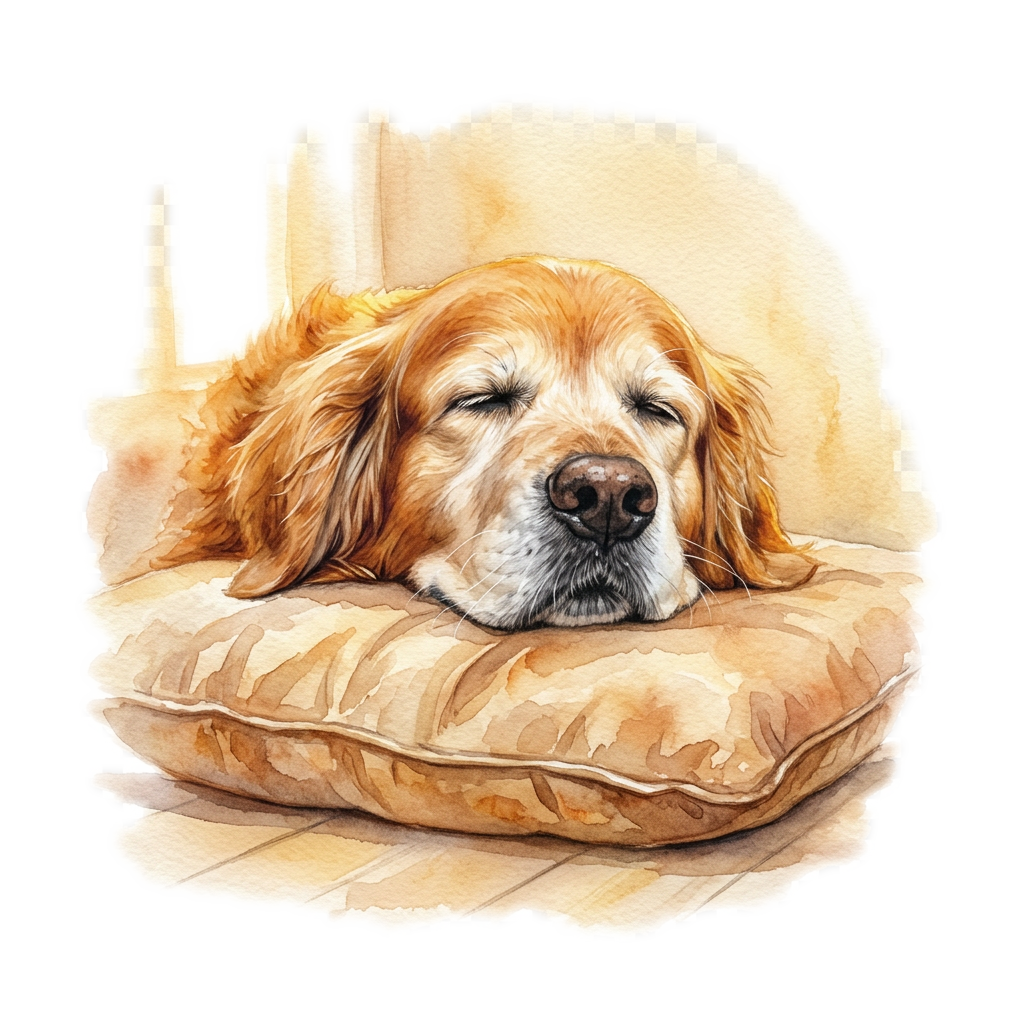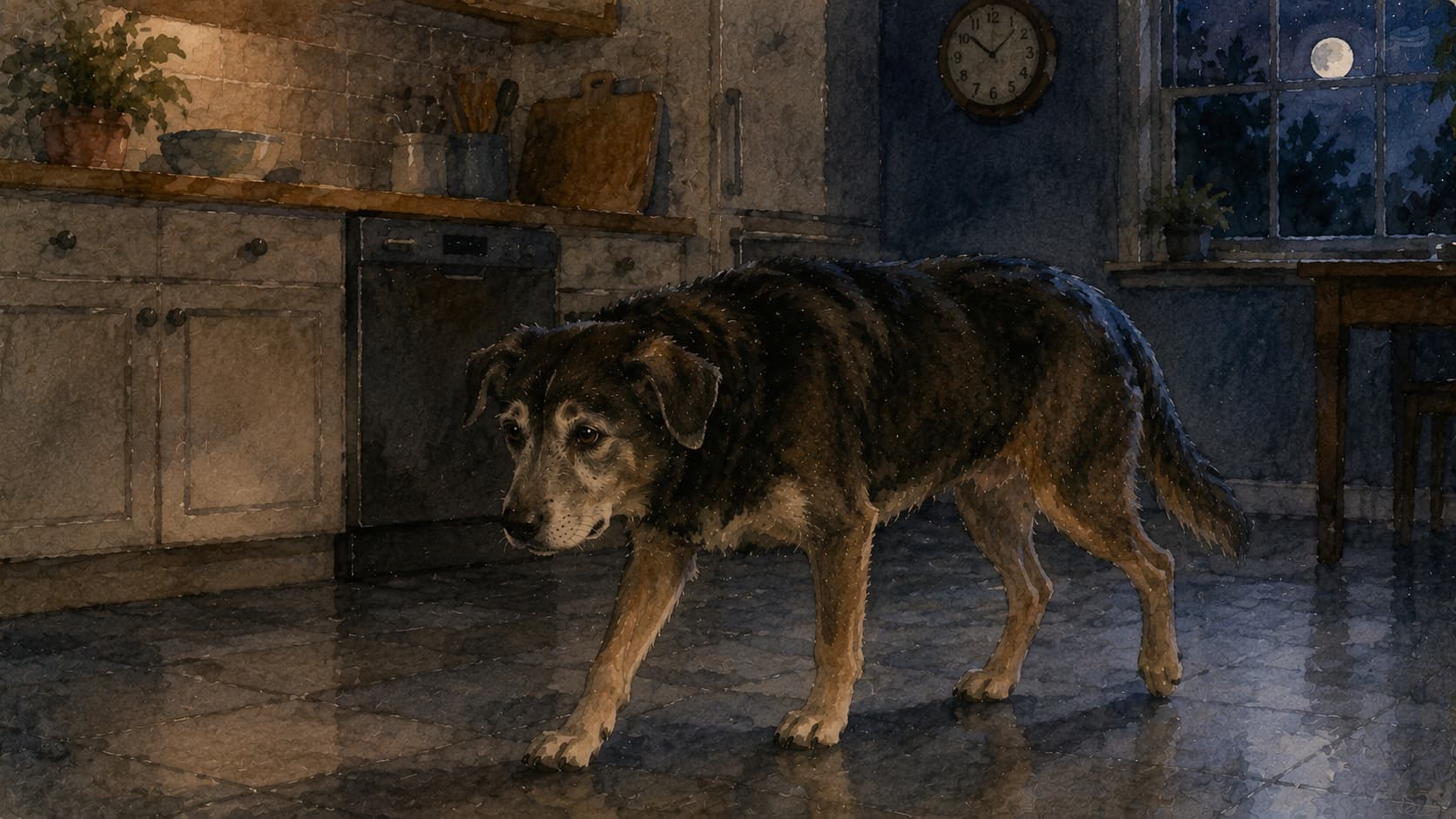
It's 2:47 AM. Your dog has been pacing the kitchen for forty minutes. You're awake — again — staring at the ceiling and wondering whether this is a phase, a problem, or something you should already have done something about. You're not the first person to ask. Senior dog pacing at night is one of the most common reasons dog owners reach out, and it almost always has more than one cause underneath it.
Senior dogs pace at night for three main reasons: cognitive dysfunction (CCD), pain (especially from joint or back issues), and sundowning. Most affected dogs have a combination of two or more contributors. The pattern typically emerges in dogs over 7–9 years old. Structured observation over 7–21 days, an evening routine with predictable cues, and a focused vet conversation about pain assessment resolve most cases.
This guide walks you through what's likely happening, what to rule out, and what to actually do — in the order most useful at the time of night when you're reading this.
We don't recommend medications, dosing, or specific supplements here. Those are vet decisions. What we cover is the home work — the observation, the environment, the routine. That work is where most of the change actually happens.
What pacing at night usually means in a senior dog
Pacing rarely points at a single cause. In a senior dog, three contributors typically stack:
Cognitive change. This is the most underestimated cause. As dogs age, the brain regions that regulate the sleep–wake cycle become less reliable. The circadian signal weakens. The dog feels tired but can't initiate sleep. They walk because their nervous system isn't doing the thing that normally tells them to lie down. If pacing is paired with confusion, slow recognition, or doorway hesitation during the day, cognitive change is likely part of the picture. (Full CCD guide here.)
Pain — especially joint and back pain. This is the most underestimated cause from the other side. A dog with arthritis or chronic stiffness can't settle because lying down hurts. They get up, walk a few steps, try a different spot, get up again. The pattern looks like restlessness but is fundamentally an inability to find a comfortable position. Pain is so often the answer that any vet conversation about night pacing should put it at the top of the list to rule out.
Sundowning. A specific time-of-day version of cognitive change, where evenings and nights are noticeably worse than days. If your dog is calm during daytime and only shifts after dusk, the pattern is probably sundowning. (Separate guide on sundowning.)
Bladder, hunger, or routine misalignment. Less dramatic, but real. A late dinner, a long gap before the last toilet trip, or a too-warm sleeping area can each contribute. These are the easiest to test for — adjust one variable for three nights and see what shifts.
The honest answer for most senior dogs: it's some mix of two or three of these. The work isn't finding the cause. The work is structured enough observation that you and your vet can figure out which ones are biggest.
A differential checklist: what to rule out first
Before deciding it's cognitive change, run through these.
Pain. Is your dog stiff when they first stand up? Reluctant on stairs? Slower into and out of lying down? Does the pacing get worse on days they were more active? If yes to any of these, talk to your vet about pain assessment. Joint pain is the single most common driver of night-time restlessness in seniors, and it's also one of the most treatable.
Bladder or urinary issues. Is your dog squatting more often, having accidents, drinking more water than usual, or showing discomfort when peeing? Urinary tract infections and other bladder issues can drive nighttime restlessness. A urine sample at your next vet visit clears this up quickly.
Hearing loss. Is your dog responding less to sounds — not just to their name, but to the doorbell, the can opener, footsteps? Hearing-impaired dogs can become more anxious at night when visual cues fade and they can't compensate auditorily. Worth knowing.
Vision changes. Is your dog bumping into furniture in low light? Reluctant to come downstairs in the dark? Hesitating at the top of stairs they've used for years? Vision loss progresses slowly and is easy to miss. Nightlights help.
Sleeping environment. Is the bed in a high-traffic area? Is the room too warm, too cool, too bright, too loud? Senior dogs become more sensitive to environmental factors as their tolerance buffer drops. A small change here sometimes makes a surprising difference.
Late meals. Is dinner happening after 7pm? A late, heavy meal pushes digestion into the night. Many dogs settle better on an earlier feeding window.
Medication side effects. If your dog is on anything new — even something seemingly unrelated like a pain medication or supplement — restlessness can be a side effect. Worth mentioning to your vet.
If you can answer "yes, this is part of it" to any of these, you've narrowed the picture. Most senior dogs have two or three contributing factors. That's normal.
Tonight: what to do in the next few hours
If you're reading this at 2am, here's the actionable version.
Don't fix it actively. The instinct is to soothe — to follow the dog, to offer treats, to talk reassuringly. Active engagement often extends the cycle. What helps more is calm proximity. Sit nearby in a low-lit room. Don't pet, don't talk, don't make eye contact. Let your steady presence be part of the environment. Most dogs settle faster in calm presence than in active soothing.
Lower the stimulation. Dim any lights still on. Reduce sound. Close curtains if the room has external light. The brain that can't initiate sleep does better with fewer competing signals.
Offer a slow chew or scatter-fed treats. Sniffing and chewing release calming neurochemicals. A long-duration chew that takes 20–30 minutes to work through can shift a dog out of pacing mode into focus mode, and often into sleep mode shortly after.
Note the time and what was happening. Date. Time the pacing started. Time it stopped. What was the dog doing before. What was different about the day. This is data. You'll want it.
If the pacing is severe — if your dog seems distressed, in pain, or unable to settle for hours — that's a different category. Call your vet's emergency line. We're describing the routine pattern here, not acute distress.
Free 2-minute DISHAA assessment
See where your dog stands across the six dimensions vets use to track cognitive change. Enter your email — we'll send your assessment and a 3-night calm plan.
Free · 2 minutes · no account · unsubscribe anytime.
This week: structured observation
For the next seven nights, log three things:
- The time pacing begins (use a notebook by the bed)
- The time your dog finally settles into sleep
- Any unusual context — late dinner, visitors during the day, schedule change, missed walk
By night four or five, patterns start emerging. You might see the pacing tied to dinner time, or to days with less exercise, or to specific weather. You might see no pattern at all, which is itself information. Either way, the data beats the memory you'll have when you sit in the vet office trying to describe what's been happening.
This week is also when to take the free DISHAA quiz. It scores cognitive change across six domains in twelve questions. If your dog scores in the moderate or significant band, that tells you cognitive change is likely a real contributor. If they score in the mild band, that points more strongly at pain, environment, or routine issues.
Want a structured way to track this? Our free DISHAA quiz gives you a baseline score and a 3-night calm plan in your inbox. Re-take it in a month and compare — patterns over time tell you more than any single reading. Take the free quiz →
This month: a structured evening routine
Most dogs respond to environmental structure within two to three weeks. Here's the routine we'd run, applied consistently for at least 14 nights before you evaluate:
4pm: Dim household lighting. Reduce overhead lights. Soften ambient sound.
5:30pm: Last meal of the day. Earlier than this works too. Avoid past 6:30.
6:30pm: A short sniff-heavy walk. Twenty minutes. Same loop every night.
7:30pm: Lights down to warm sources only. Curtains closed.
8:30pm: A long-duration chew, in a quiet corner near you. Don't engage actively — sit nearby and read.
9:30pm: Last toilet break. Same door, same loop.
10:00pm: Lights to minimum. Bed.
The specific times matter less than the consistency. Same sequence, same order, every night. Your dog's brain — even a brain working with reduced cognitive headroom — learns the rhythm. After two weeks, the routine becomes a cue in itself.
Three weeks in, take the DISHAA quiz again. Compare scores. Decide whether what you've done is enough, or whether to add the next layer.
When to involve your vet
Some patterns deserve a vet visit sooner than later.
- Pacing that started suddenly, in days rather than weeks
- Pacing paired with appetite changes, lethargy in daytime, or new physical symptoms
- Vocalising that sounds distressed (yelping, crying) rather than restless
- Signs of pain — stiffness on rising, reluctance with stairs, sensitivity to touch
- Any new water-drinking patterns or urination changes
Bring observations, not just descriptions. Three weeks of logged nights with start time, settle time, and context give your vet ten times more to work with than "she's been pacing a lot."
What the Hearthside Method adds, if you want more
The pattern we just described is the first three weeks of the full eight-week Hearthside Method. The Method is the structured at-home care system that builds on it: layered sleep support strategies, mobility-aware morning routines, cognitive engagement built for senior dogs, sundowning-aware evening structure, weekly observation worksheets, and a complete daily rhythm that runs alongside whatever your vet recommends.
If what you've already started works, that's the right answer for you. If you want the structured version, the Method is built for that.
Either way: tonight is a reasonable starting point. The dog you love is still in there, and you have more options than you might feel like you do at 2:47 AM.
Frequently asked questions
Common questions dog owners ask about this. We answer plainly and stay in our lane.
Why is my senior dog pacing at night all of a sudden?+
Sudden-onset pacing in a senior dog deserves a vet visit. It can have non-cognitive causes — pain, a urinary tract issue, vision change, medication side effect, or systemic illness — that need ruling out before assuming cognitive dysfunction. Bring three to seven nights of observations.
Is night pacing a sign of dementia in dogs?+
It can be. Cognitive dysfunction (CCD) is one of the most common drivers of night pacing in senior dogs. But it's rarely the only cause — pain (especially joint pain) is just as common and often overlaps. Our free DISHAA quiz scores cognitive change across six domains and helps clarify how much CCD is contributing.
How do I stop my old dog from pacing at night?+
Most dogs respond to a structured evening routine within two to three weeks. Step down lights from 4pm, feed by 5:30, take a short sniff walk after dinner, soften sound by 7:30, offer a long chew at 8:30, last toilet by 9:30, settle by 10. Same sequence every night. Calm proximity helps more than active soothing.
Should I be worried if my old dog is pacing at night?+
Worried is not the right frame — observant is. Three to seven nights of logged observations will tell you whether this is an emerging pattern or a one-week blip. If pacing is paired with pain signals, appetite changes, distressed vocalising, or any sudden onset, that's a vet conversation. Otherwise, you have time to observe and structure first.
What can I give my senior dog to help him sleep at night?+
That's a question for your veterinarian. There are real options — prescription approaches, dietary approaches, and supplements with research behind them — but the right choice depends on your dog's full medical context, current medications, and what's actually driving the night pacing. We don't recommend specific products. The home routine described above works alongside, not instead of, whatever your vet recommends.
Why does my old dog walk around at night and not sleep?+
Three contributors usually stack: cognitive change (the sleep–wake regulation gets noisy), pain that makes lying down uncomfortable, and routine factors like late meals or environmental sensitivity. Most senior dogs have two or three of these at once. Structured observation and an evening routine address most cases; vet involvement handles what's left.
Sources
Authoritative references underlying this guide. Linked for verification.
- Cognitive Dysfunction SyndromeCornell University Riney Canine Health Center
- Managing Cognitive Dysfunction and Behavioral Anxiety (2023 Senior Care Guidelines)American Animal Hospital Association
- Updates on Cognitive Dysfunction Syndrome (Jan/Feb 2025)Today's Veterinary Practice
Tom writes Hearthside's long-form guides on senior dog cognitive change and home-care frameworks. He's spent years living alongside aging dogs, and that perspective shapes every guide — alongside the veterinary research we cite.
Free 2-minute DISHAA assessment
See where your dog stands across the six dimensions vets use to track cognitive change. Enter your email — we'll send your assessment and a 3-night calm plan.
Free · 2 minutes · no account · unsubscribe anytime.
The 8-week Hearthside Method
A structured plan for the dog you've loved your whole life.
Discover the Method