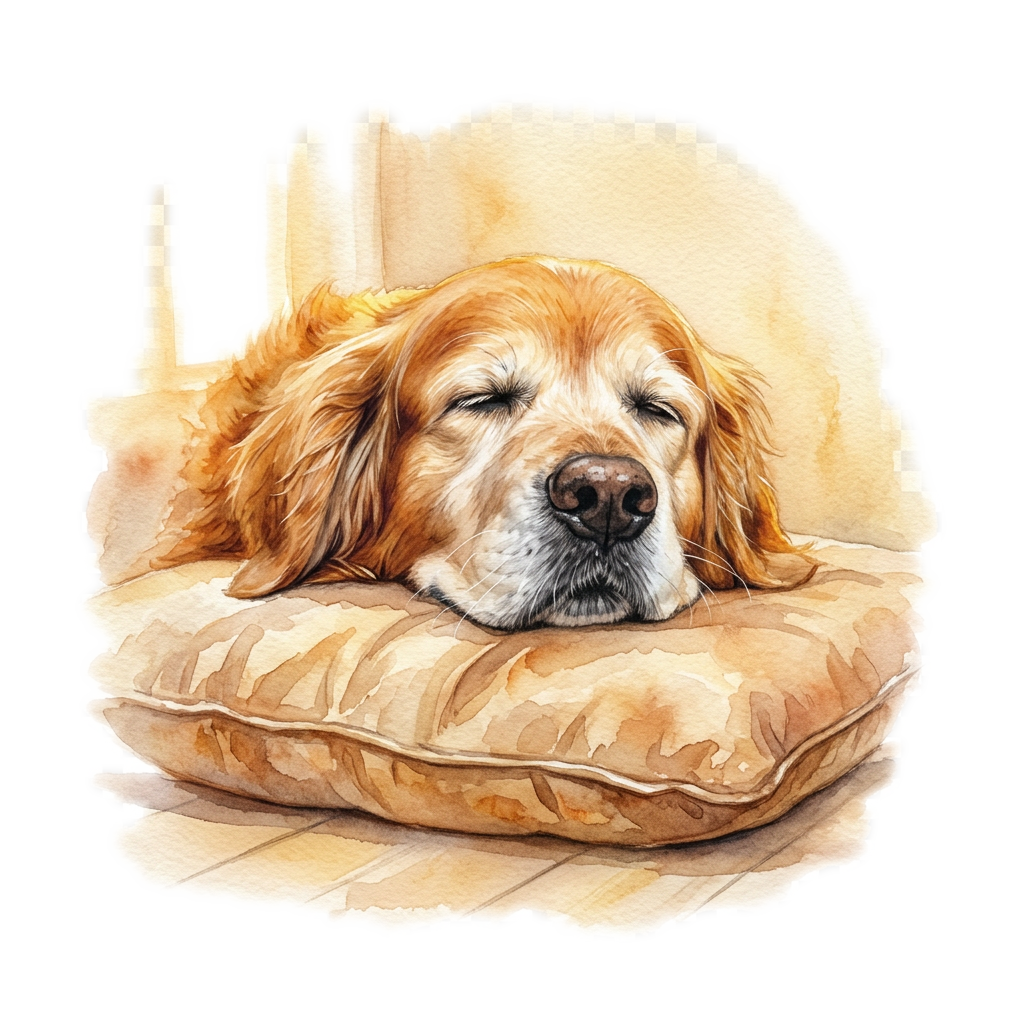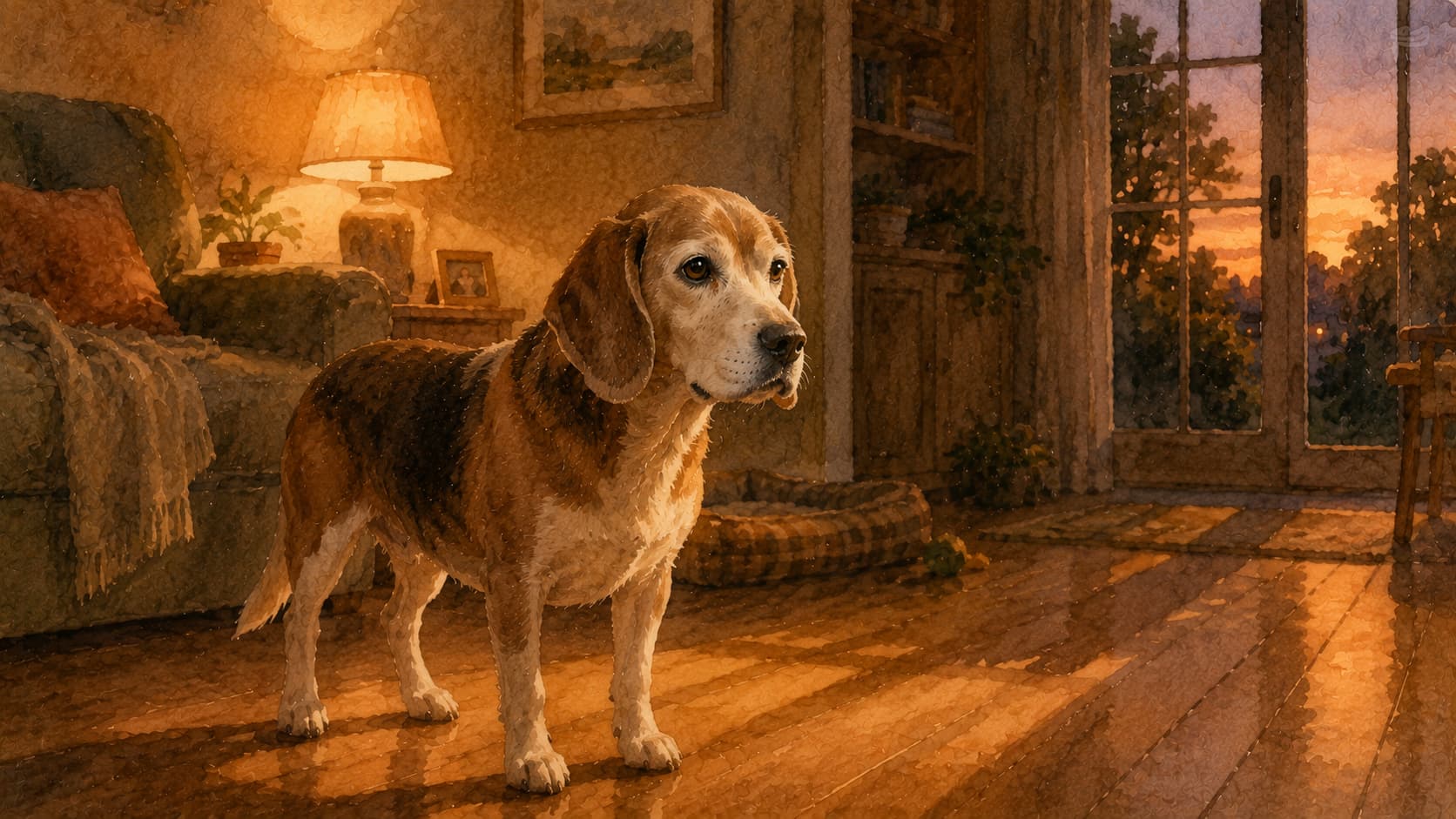
Every evening around 6pm, something changes. Your dog — calm all day — starts pacing. Then panting. Then the whining starts, or the staring at nothing, or the restlessness that won't end until well past midnight. By morning they're flat-out tired, sometimes exhausted, and the cycle waits to start again at dusk. If that's familiar, what you're describing has a name. It's also more manageable than most owners realise.
Sundowning in dogs is a pattern of increased confusion, restlessness, and anxiety that occurs in the late afternoon and evening hours, typically between 4 PM and bedtime. It is one of the most visible expressions of canine cognitive dysfunction (CCD) and is caused by circadian rhythm disruption, cumulative cognitive fatigue, and weakened environmental cues at dusk. Sundowning typically begins between 7 and 9 years of age.
Sundowning is the most loaded hour in the senior dog day. Most other CCD symptoms — confusion at a doorway, slow response to a name — are quiet, occasional, easy to dismiss. Sundowning isn't. It walks into your evening every single night and it stays for hours.
The good news: it's also the most responsive symptom to structure. Of all the things we cover at Hearthside, the dusk-to-bedtime window is where small changes pay the biggest dividend. This guide walks you through what's happening and what to do about it.
What is sundowning in dogs?
Sundowning is a pattern, not a diagnosis. It describes a senior dog who becomes noticeably more confused, agitated, restless, or anxious in the late afternoon and evening hours — typically between 4pm and bedtime, with the peak somewhere between 7pm and 11pm.
The term is borrowed from human dementia care, where it describes the same time-of-day pattern in people with Alzheimer's and related conditions. The mechanism in dogs is similar enough that the borrowed name fits.
If you're seeing this pattern, your dog's underlying condition is almost certainly canine cognitive dysfunction (CCD — full guide here). Sundowning is one of the more visible expressions of CCD, particularly in dogs who fall into the moderate to significant bands of the DISHAA scale.
What sundowning actually looks like in real homes
The pattern owners describe is consistent enough to be predictable:
- Calm daytime. The dog acts mostly like themselves through morning and early afternoon. Nothing especially wrong.
- The shift starts around 4–6pm. Restlessness creeps in. Pacing begins. Panting starts even though the house isn't warmer than usual.
- Peak between 7–11pm. Pacing intensifies. Some dogs vocalise — whining, barking at nothing, occasional howls. Some get stuck in spots — a corner, behind the couch, facing a wall. Many won't settle even when visibly tired.
- Late-night exhaustion. Eventually, somewhere between midnight and 2am, the dog drops into sleep. Often a heavy one.
- Morning is quieter. Wake-ups are still a thing, but the dog often seems mostly normal again by 7am.
What makes it confusing is the contrast. A dog who's been calm and recognisable all day becomes a different animal at dusk. That contrast is what tells you you're looking at a time-of-day pattern, not a continuous decline.
Why evenings get harder — the biology
Three things converge.
Circadian rhythm disruption. CCD directly affects the brain regions that regulate the sleep–wake cycle. The internal clock gets noisy. Light cues that used to help the brain wind down don't land as cleanly. The dog isn't choosing not to settle; their wind-down machinery isn't firing properly.
Cumulative cognitive fatigue. A dog with mild cognitive change can handle the day with effort. By 6pm, the brain has been working all day at a slight cognitive deficit, and the buffer is gone. What was easy in the morning is exhausting by evening.
Environmental cues recede. Daylight fades. Household activity slows. The cues your dog has used for years to know "this is winding-down time" weaken or change. A brain that depends more on cues — as a cognitively-affected brain does — has fewer to lock onto.
This is also why structure helps. Predictable cues replace the failing biological ones.
Is sundowning the same as canine cognitive dysfunction?
Not quite. Sundowning is a symptom pattern. CCD is the underlying condition. Most dogs with sundowning have CCD; most dogs with CCD show some degree of sundowning, though severity varies.
Two reasons this distinction matters at home:
If your dog has sundowning, the larger CCD picture is worth understanding (we cover it in the pillar guide). It's likely that other DISHAA domains are also affected to some degree — sleep–wake is the loudest, but it's rarely alone.
If your dog doesn't have other CCD signs and the evening agitation is recent and acute, that's worth a vet visit. Sudden-onset agitation can sometimes have non-cognitive causes (pain, urinary tract issue, sensory change, medication side effect). The slow-onset, weeks-and-months pattern is what points specifically at sundowning.
Free 2-minute DISHAA assessment
See where your dog stands across the six dimensions vets use to track cognitive change. Enter your email — we'll send your assessment and a 3-night calm plan.
Free · 2 minutes · no account · unsubscribe anytime.
At what age does sundowning start?
The same age window as CCD generally: 7 to 9 years and up, earlier in larger breeds. The first signs are quieter than the late-stage pattern most owners describe when they come looking for answers.
Early sundowning looks like: ten extra minutes of restlessness after dinner. A small, easy-to-miss pacing window between 6 and 7pm that resolves on its own. A subtle increase in panting at dusk. Most owners notice the loud version — the 9pm vocalising, the 2am pacing — and don't realise it's been speaking quietly for months.
If you're catching the quiet version, you're in the best position to intervene. The evening routine we describe below works far better at the early stage than it does later.
Want to know where your dog stands across all six DISHAA domains? Our free 12-question quiz takes two minutes and gives you a baseline you can re-take monthly. Sleep–wake is one of the six domains we score. Take the free quiz →
A dusk-to-bedtime routine that works for most dogs
This is the differentiator. Most articles on sundowning list generic tips. The routine below is structured by time block, because the time-of-day pattern is exactly what's broken.
4:00 PM — Preparatory phase. Start dimming household lighting. Turn off any bright overhead lights if natural daylight is still available. The brain needs strong cues that "evening is starting" before evening actually starts. Begin softening household sounds — TV down a notch, less foot traffic if possible.
5:30 PM — Last meal of the day. A predictable feeding window helps anchor the body's internal clock. Avoid feeding much later than this if you can — late meals push the digestive cycle into the night-time, which compounds wake-ups.
6:30 PM — The transition walk. A short, sniff-heavy walk after dinner. Twenty minutes is enough for most senior dogs. The point is not exercise — it's sensory engagement and a clear "we're heading toward settling" signal. Walk the same loop every night. Predictability matters more than novelty here.
7:30 PM — Lights down, sound down. Reduce ambient light to soft, warm sources only. Close curtains. If you can run a low white-noise source (fan, gentle music at low volume), now is the time. The household has visibly entered wind-down mode.
8:30 PM — Slow chew, settled spot. Offer a long-duration chew that takes 20–30 minutes to work through. Put your dog's bed somewhere quiet, near you but not in the action zone. Sit nearby without engaging much. Active soothing often makes anxiety worse; calm proximity helps it release.
9:30 PM — Last out for the toilet. The same loop. Same time. Same door.
10:00 PM — Settle. Lights down to bare minimum. If your dog has a usual bed, this is the time. If they tend to pace before sleeping, sit with them quietly until they settle.
Three things make this routine work, not the specific times.
Predictability. Same sequence, every evening, for at least two weeks before evaluating. The brain learns the rhythm.
Sensory progression. Light, sound, and activity all step down together. The dog's environment carries the cues their brain can't generate.
Your presence is calm, not engaged. This is the hardest one. Don't try to fix the pacing. Don't follow them around offering reassurance. Sit nearby. Read. Let your steady presence be part of the environment.
When to involve your vet
Sundowning that's been going on for months, in a senior dog, with the pattern we described above — that's CCD-flavoured sundowning and the home work above is the right starting point.
But these patterns deserve a vet visit:
- Sundowning that started suddenly, in days rather than weeks
- Sundowning paired with new physical symptoms (limping, changed appetite, drinking more water than usual, eye changes)
- Sundowning with vocalising that sounds different from normal — yelping, crying, or what sounds like distress rather than confusion
- Any case where your dog seems to be in pain, not just agitated
Your vet will want to rule out conditions that mimic sundowning's evening pattern — pain that flares with activity, urinary tract issues, vision changes that worsen at dusk, medication side effects.
What to bring to that conversation
Three weeks of evening observations beats anything else you could prepare:
- The time agitation starts, each night
- The time the dog finally settles
- What the agitation looks like (pacing, panting, vocalising, staring)
- Anything unusual that happened that day before the evening (visitors, schedule change, new food)
- Sleep duration overnight and wake-up count
Your vet will appreciate the dataset more than a vague description. And our free DISHAA quiz log gives you a structured place to capture it.
The structured version: the full evening, every evening
The dusk-to-bedtime routine above is the first thing most owners introduce. It's also one piece of a larger picture. The Hearthside Method is the eight-week structured framework that builds on it — sundowning-aware evening structure, layered sleep support strategies, mobility-aware morning routines that affect how the evening lands, cognitive engagement throughout the day, and the weekly observation that tells you whether what you're doing is working.
The Method runs alongside whatever your vet recommends, not instead of it. If your dog's evenings are hard right now, this is what we'd hand you on night one. One supportive change per week, building into a complete daily rhythm by week eight.
See inside the Hearthside Method →
You can manage this. Tonight is a reasonable starting point.
Frequently asked questions
Common questions dog owners ask about this. We answer plainly and stay in our lane.
What is sundowning in dogs?+
Sundowning is a pattern where a senior dog becomes noticeably more confused, restless, or agitated in the late afternoon and evening — typically between 4pm and bedtime, peaking around 7–11pm. It's not a separate condition; it's a time-of-day expression of canine cognitive dysfunction (CCD).
At what age do dogs get sundowners?+
Usually from age 7–9 onward, earlier in larger breeds whose biological aging is faster. Early sundowning is quieter than the full-blown evening pattern — small bouts of restlessness around dusk that owners often dismiss for months before the louder symptoms appear.
Is sundowning the same as dog dementia?+
Closely related but not identical. Sundowning is one symptom pattern within the broader picture of canine cognitive dysfunction (CCD, or 'doggy dementia'). Most dogs with sundowning have CCD; most dogs with CCD show some degree of sundowning.
How do I help my dog with sundowning?+
A predictable dusk-to-bedtime routine helps most dogs. Step down lighting from 4pm, feed by 5:30, take a short sniff walk after dinner, reduce ambient sound by 7:30pm, offer a slow chew around 8:30, and settle by 10pm. Same sequence every evening for at least two weeks before evaluating. Calm proximity helps anxiety release faster than active soothing.
Should I give my dog something for sundowning?+
That's a question for your veterinarian. There are real options — medications, dietary approaches, and supplements with research behind them — but the right choice depends on your dog's medical context. We don't recommend specific products. The home routine described in this guide works alongside, not instead of, anything your vet recommends.
When should I take my dog to the vet about sundowning?+
If the pattern started suddenly (days rather than weeks), if it's paired with new physical symptoms like limping or appetite change, if the vocalising sounds distressed rather than confused, or if your dog seems to be in pain. Also any time you want a clearer picture — bring three weeks of evening observations with you.
Sources
Authoritative references underlying this guide. Linked for verification.
- Cognitive Dysfunction SyndromeCornell University Riney Canine Health Center
- Managing Cognitive Dysfunction and Behavioral Anxiety (2023 Senior Care Guidelines)American Animal Hospital Association
- Physical signs of canine cognitive dysfunction (Schütt et al)PMC / National Institutes of Health



Tom writes Hearthside's long-form guides on senior dog cognitive change and home-care frameworks. He's spent years living alongside aging dogs, and that perspective shapes every guide — alongside the veterinary research we cite.
Free 2-minute DISHAA assessment
See where your dog stands across the six dimensions vets use to track cognitive change. Enter your email — we'll send your assessment and a 3-night calm plan.
Free · 2 minutes · no account · unsubscribe anytime.
The 8-week Hearthside Method
A structured plan for the dog you've loved your whole life.
Discover the Method