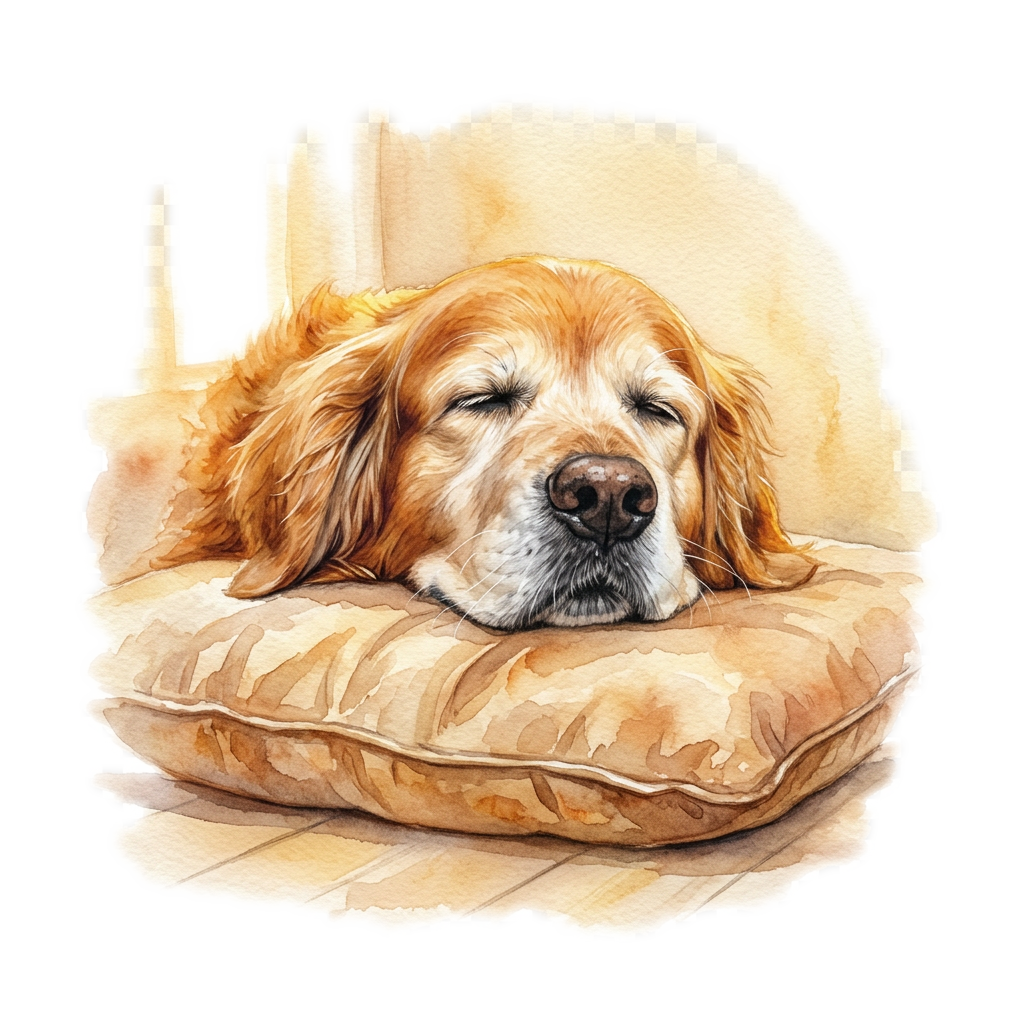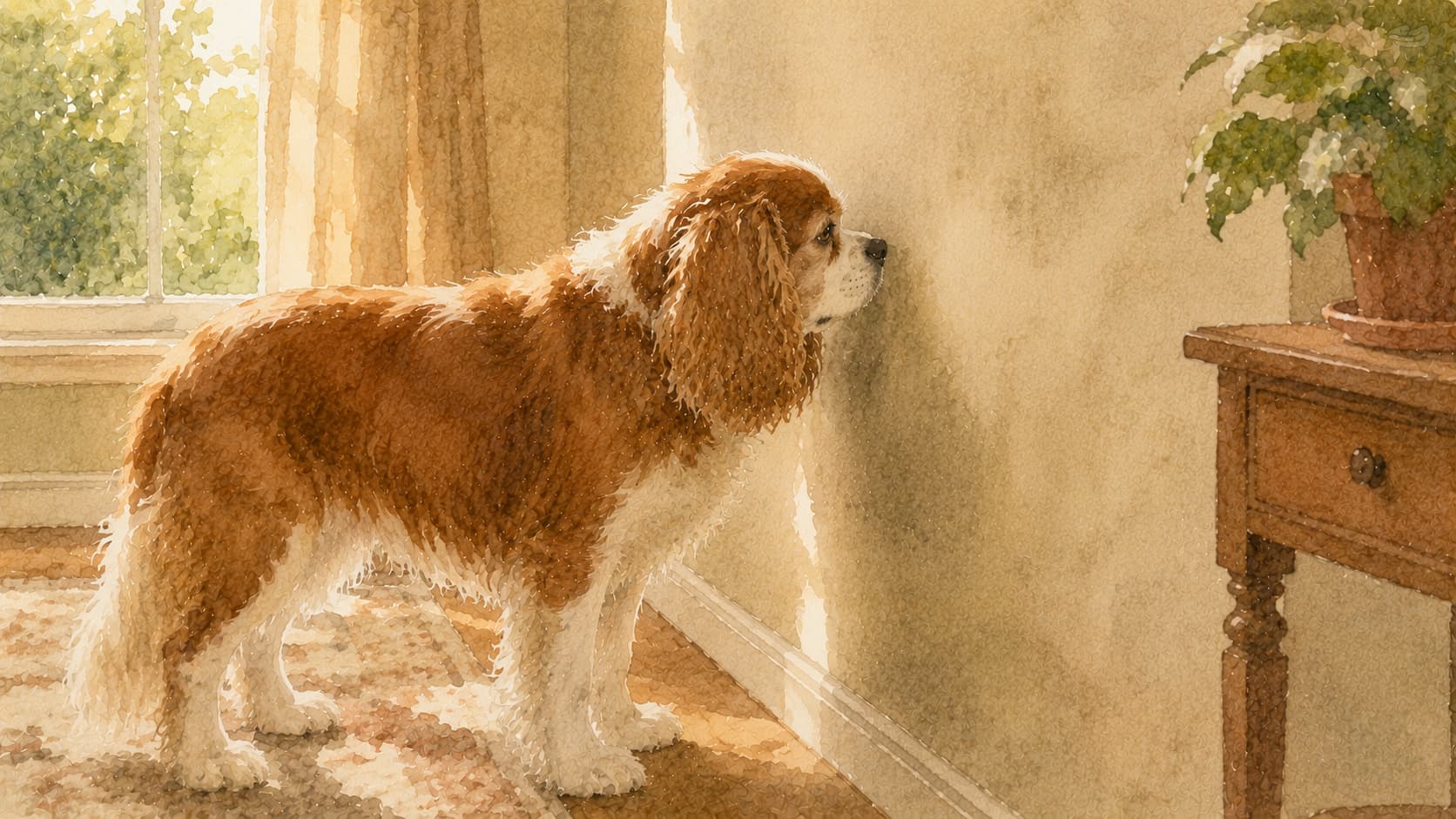
She faces the wall like she's reading something. He stands in the corner for two full minutes, then turns around and walks away like nothing happened. You watch it once and dismiss it. The second time, you film it on your phone. By the fifth or sixth time, you're typing 'why is my old dog staring at the wall' into Google, which is probably how you got here.
In a senior dog, recurring "stuck" moments at walls or in corners are most often a sign of mild to moderate canine cognitive dysfunction (CCD) — specifically in the disorientation domain. Episodes typically last 30 seconds to a few minutes, resolve on their own, and the dog acts normal afterward. This pattern is different from head pressing, which is a serious neurological warning sign requiring immediate veterinary attention.
Most of what you'll find online about dogs staring at walls falls into two camps. Either generic "ten possible reasons" listicles that don't help you decide what to do, or alarming articles about brain tumours and seizures that scare you without telling you whether what your dog is doing is actually that.
We'll do something different. First we'll cover what staring at walls usually means in a senior dog — the calm, slow-onset kind. Then we'll cover head pressing, which is the version that needs a vet visit today, not next week. Then a differential checklist so you can place what your dog is doing.
What staring at walls usually means in a senior dog
In dogs over 7–8 years old, recurring "stuck" moments — staring at walls, standing in corners, freezing in odd spots — are most often a sign of cognitive change. Specifically, mild to moderate canine cognitive dysfunction (CCD — full guide) in the disorientation domain.
What's happening: the brain regions that handle spatial awareness, motor planning, and short-term memory become less reliable with age. The dog finds themselves in a position (facing a wall, behind a piece of furniture, in a doorway) and momentarily can't access the cognitive script for "what was I doing? how do I get out of here?" The pause is the brain working through it.
A few characteristics of the cognitive-change version:
- Gradual onset. The behaviour develops over weeks or months. Not days.
- Episodes are brief. Typically thirty seconds to a few minutes. The dog eventually moves out of it on their own.
- The dog is otherwise normal afterward. No tremor, no disorientation that persists, no obvious distress.
- Recurring in similar spots. Often a particular corner, a specific piece of furniture, a doorway.
- Other DISHAA signs are present. Slower greeting, occasional indoor accident, restless evenings. The staring isn't happening in isolation.
This pattern is upsetting to watch and almost always less alarming than it feels. The work here is observation and environmental support, not panic.
When staring is something else: head pressing
There is one pattern that is not benign and that we want to be specific about.
Head pressing is when a dog actively pushes the top of their head against a wall, the floor, or furniture and holds it there. Not standing near a wall, not staring at a wall — pressing into it. Sometimes for minutes at a time. Sometimes paired with circling, disorientation that doesn't resolve, vision changes, or seizure-like episodes.
Head pressing is a neurological warning sign. The most common underlying causes are:
- Liver disease (hepatic encephalopathy)
- Brain tumour or other intracranial conditions
- Toxin exposure
- Severe metabolic disturbance
It is a call your vet today symptom. Not next week. Not "let's watch it for a few days." Today.
If you're not sure whether your dog is staring at a wall (usually fine) or pressing into one (urgent), the test is contact. Is your dog's head actively pressed against the surface, with weight on it, holding the position? That's head pressing. Are they standing near the wall, facing it, but not making contact? That's the cognitive-change version we covered above.
When in doubt, call. The downside of a precautionary vet call is small. The downside of missing head pressing isn't.
A differential checklist: what staring could be
Beyond the cognitive change vs head pressing distinction, several other conditions can cause a dog to seem "stuck" or staring.
Partial seizures. Some seizures don't look like full-body convulsions. A focal seizure can present as staring into space, unresponsive for thirty to sixty seconds, then gradually returning. If the episodes look almost identical each time, last about the same length, and end with the dog seeming briefly confused — that's worth a vet conversation about seizure activity.
Vision changes. Senior dogs with declining vision sometimes stand in odd spots because they're orienting by sound or smell instead of sight. They may stare at walls in low-light conditions. A simple eye exam at the vet (sometimes including a referral to a veterinary ophthalmologist) clarifies this quickly.
Hearing loss. A dog that can't hear well may stand still, scanning for cues, in situations where they used to move confidently. This can look like staring or freezing.
Pain. A dog in pain sometimes finds a position that minimises it and stays there longer than they normally would. If the staring is in spots where it would be hard to bear weight (against a wall for support, in a corner that supports their back), pain is worth considering.
Stroke or vestibular events. Acute-onset disorientation — sudden, severe, paired with head tilt, loss of balance, or rapid eye movement — is a different category. That's an emergency vet visit.
Anxiety patterns. A small subset of dogs develop anxiety behaviours that include freezing or staring. This is more often in dogs with anxious histories than in dogs whose anxiety just emerged in their senior years.
The pattern that points most strongly at cognitive change is: gradual onset, brief episodes, normal afterward, recurring in similar spots, other senior-dog signs present.
Free 2-minute DISHAA assessment
See where your dog stands across the six dimensions vets use to track cognitive change. Enter your email — we'll send your assessment and a 3-night calm plan.
Free · 2 minutes · no account · unsubscribe anytime.
What to observe this week
If you've decided this is the slow, cognitive-change version (not head pressing, not acute), the most useful thing you can do is structured observation.
For each episode, note:
- The date and time
- How long it lasted (rough estimate)
- Where it happened (which corner, which wall, which room)
- What was happening before
- How your dog acted right after — confused, normal, sleepy
A week of these notes will tell you whether this is happening once a day, three times a day, or six times. It will also tell you if there are patterns — does it happen more in the evening (suggests sundowning), more after meals (suggests something digestive or metabolic), more in low light (suggests vision)?
The notes are also the right input for a vet visit. Walking in with "she stares at walls sometimes" is hard to act on. Walking in with seven dated, timed observations is a different conversation entirely.
Want to score the bigger picture across six DISHAA domains? Our free 12-question quiz takes two minutes and tells you where your dog sits on disorientation, sleep–wake, social interaction, and three other domains. Plus a 3-night calm plan in your inbox. Take the free quiz →
What helps at home
If the pattern fits cognitive change in the disorientation domain, three environmental shifts make a real difference.
Simplify the home. Don't rearrange furniture. Keep paths between bedroom, food bowl, water bowl, and back door clear and unchanged. The brain that's losing its spatial map does much better in a familiar, unchanging environment.
Add nightlights. Low light in hallways, near the water bowl, on the path to the back door. Dogs that get "stuck" in low-light areas often resolve once the environment is more visible. This is one of the highest-return-on-effort interventions.
Reduce environmental noise. Sudden sounds — a slammed cabinet, a doorbell, a startled cat — can extend a disorientation episode. Reducing baseline noise in the home (especially in the evening) helps.
Don't intervene during episodes. When you see your dog standing in a corner, the instinct is to call them, guide them, soothe them. Most dogs work out of it faster on their own. Calm, quiet proximity is fine. Active engagement often extends the episode.
This is also the home work that the full eight-week Hearthside Method walks you through — week by week, with printable trackers — if you want a structured version.
When to involve your vet
A short version of the criteria:
See a vet today if: any head pressing, sudden onset of severe disorientation, head tilt, balance loss, rapid eye movement, paired with seizure-like activity, paired with severe lethargy or appetite loss.
Schedule a vet visit this week if: episodes are becoming more frequent, the dog seems distressed during or after, other CCD signs (sleep–wake, indoor accidents, social withdrawal) are showing up, vision or hearing changes are part of the picture.
Mention it at the next regular visit if: episodes are brief, infrequent, the dog is otherwise normal, and you have observations to share. Bring the log.
The most common outcome of a non-urgent vet visit for this pattern is a basic exam (especially eyes, ears, neurology) and a recommendation to monitor. If the vet thinks cognitive dysfunction is in play, they may use a tool like DISHAA or CADES to score it. We've written a plain-language DISHAA guide so you know what to expect from that conversation.
The bottom line: this is one of the more visible signs of senior dog cognitive change, and one of the most responsive to observation plus environment. It's also worth the five-minute mental check we just walked through to rule out the urgent versions. Both checks done, you can act steadily.
Frequently asked questions
Common questions dog owners ask about this. We answer plainly and stay in our lane.
What does it mean when an old dog stares at the wall?+
Most often, brief recurring 'stuck' moments at walls or corners in a senior dog reflect mild to moderate cognitive change — specifically in the disorientation domain of the DISHAA framework. The brain regions that handle spatial awareness become less reliable with age. Episodes typically last 30 seconds to a few minutes, resolve on their own, and the dog acts normal afterward.
Is staring at walls a sign of dementia in dogs?+
It can be. Repeated, gradual-onset 'stuck' moments at walls or in corners are one of the most common early signs of canine cognitive dysfunction (CCD), the canine equivalent of dementia. The pattern that points at CCD is gradual onset over weeks, brief episodes, normal behaviour afterward, recurring in similar spots, and other DISHAA-domain changes (sleep, social, activity) present too.
What is head pressing in dogs and is it the same as staring at walls?+
No — head pressing is a serious neurological warning sign that's distinct from staring. Head pressing means the dog is actively pushing the top of their head against a wall, floor, or furniture and holding it there with weight on it. Causes can include liver disease, brain tumour, toxin exposure, or severe metabolic disturbance. Head pressing is a call-your-vet-today symptom, not a wait-and-watch one.
Could my dog be having a seizure when staring at the wall?+
Possibly. Partial (focal) seizures can present as unresponsive staring, typically 30–60 seconds, ending with brief confusion. The pattern that suggests seizures: episodes are almost identical each time, similar length, and the dog seems briefly disoriented afterward. If you suspect this, video an episode and show it to your vet — that's far more useful than a verbal description.
Should I be worried about my dog staring at the wall?+
If episodes are brief, recurring in similar spots, the dog is normal afterward, and there's no head pressing or acute disorientation — observe and structure (the cognitive-change version). If any head pressing, sudden severe onset, head tilt, balance loss, or seizure-like activity is present — call your vet today, not next week.
How do I get my dog to stop staring at the wall?+
Stopping individual episodes is less useful than reducing how often they happen. Simplify the home (no furniture rearrangement, clear paths between key spots), add nightlights in hallways and key rooms, reduce baseline household noise especially in evenings. During an episode itself, calm proximity helps more than active engagement.
Sources
Authoritative references underlying this guide. Linked for verification.
- Cognitive Dysfunction SyndromeCornell University Riney Canine Health Center
- Physical signs of canine cognitive dysfunction (Schütt et al)PMC / National Institutes of Health
- CCDS Working Group: Guidelines for diagnosis and monitoring (2026)Journal of the American Veterinary Medical Association
Sara reviews the veterinary literature behind Hearthside's content and ensures every claim links back to a citable source. Her focus areas: the DISHAA framework, sundowning patterns, and sleep–wake dysregulation in aging dogs.
Free 2-minute DISHAA assessment
See where your dog stands across the six dimensions vets use to track cognitive change. Enter your email — we'll send your assessment and a 3-night calm plan.
Free · 2 minutes · no account · unsubscribe anytime.
The 8-week Hearthside Method
A structured plan for the dog you've loved your whole life.
Discover the Method