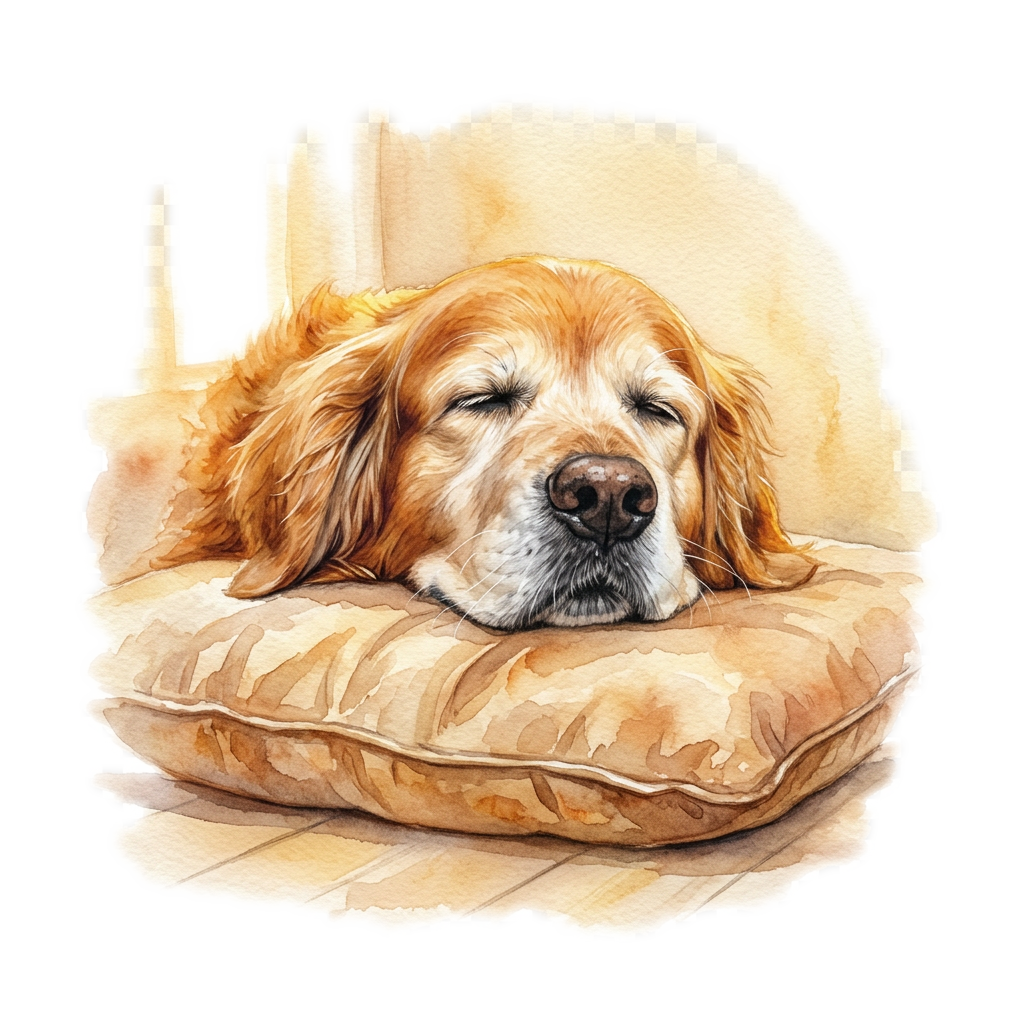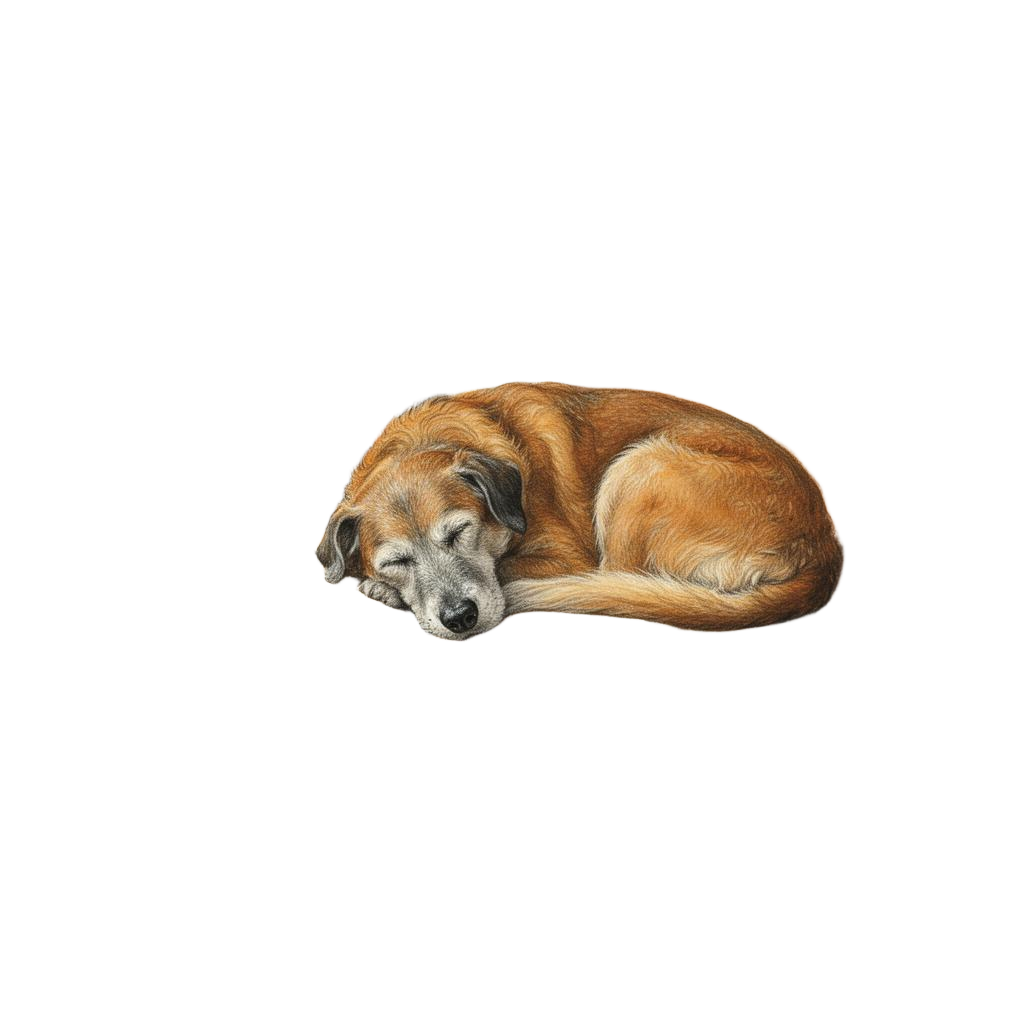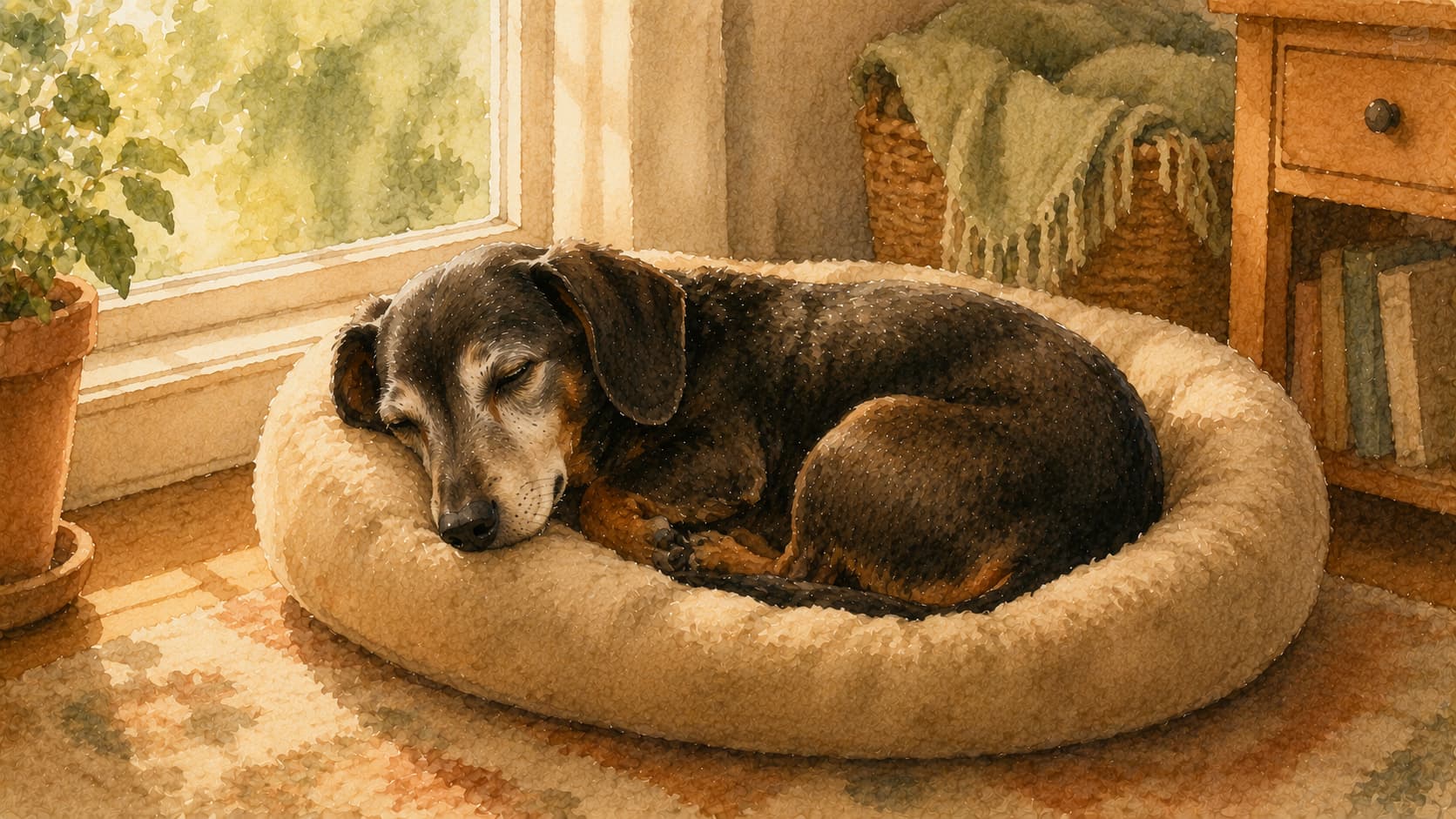
She used to sleep through the night on the floor next to your bed. Now she's awake at 1:47 AM, then 3:22, then 4:50. By 6 AM you're exhausted and she's flat-out asleep — the kind of sleep that lasts most of the morning. Senior dog sleep changes are one of the most disruptive parts of the senior years, for both of you. They're also one of the most responsive to structure, once you understand what's actually shifting.
Senior dogs typically sleep 16–18 hours per day total, but the hours redistribute — more sleep during the day, less consolidated sleep at night. This shift is caused by age-related changes in circadian rhythm regulation, lighter sleep architecture, and weaker environmental cues. Most senior sleep disruption responds within 2–3 weeks to a structured evening routine, an earlier feeding window, and consistent daily anchors.
Most articles on this topic give you the same three tips and stop. We'll cover the biology first, because understanding why sleep flips makes the routine that follows actually land. Then we'll cover what to track, what to change, and when to bring it to your vet.
What's actually changing in your senior dog's sleep
Three things shift, often simultaneously.
Circadian rhythm regulation weakens. The brain regions that coordinate sleep–wake cycles — especially the suprachiasmatic nucleus, which acts as the internal clock — become less reliable with age. The signal that says "it's evening, wind down" doesn't fire as crisply. The morning wake-up cue is similarly fuzzy. The clock starts running slightly off-time, and the dog's sleep distributes more chaotically across the 24-hour day.
Sleep architecture changes. Senior dogs spend less time in deep restorative sleep (slow-wave sleep) and more time in lighter sleep stages. They wake more easily and fall back into deep sleep more slowly. The result: more wake-ups, less restorative effect from each hour of sleep.
Sleep–wake balance flips. Younger dogs do most of their sleeping at night. Senior dogs progressively shift toward more daytime sleep and less consolidated night sleep. By advanced senior age, many dogs sleep upward of 16-18 hours total per day, but the hours are scattered across the full 24-hour cycle instead of concentrated overnight.
This isn't laziness, and it isn't a choice. It's the same biology, in slightly different form, that produces age-related sleep changes in humans. The dog is doing the best they can with a sleep system that's working with less consistent inputs.
The reason this matters at home: trying to force your dog back to the sleep pattern they had at age 4 doesn't work, because the underlying biology has changed. What does work is supporting the new pattern in a way that minimises night disruption — for them and for you.
When is age-related sleep change something more?
Some sleep shifts are normal senior aging. Some are signals of underlying conditions that need attention.
Probably normal senior aging:
- Sleeping more during the day, less at night
- Some occasional wake-ups overnight that resolve quickly
- A slow, gradual shift over months or years
- The dog otherwise acts like themselves during the day
Worth a vet conversation:
- Sudden onset of significant sleep disruption (days rather than weeks)
- Nighttime pacing or vocalising that lasts hours
- Sleep disruption paired with new physical signs — limping, appetite change, weight loss, increased water intake
- Signs that suggest pain — stiffness on rising, sensitivity to touch, reluctance with stairs
Worth ruling out as part of the picture:
- Canine cognitive dysfunction (CCD — full guide). Sleep–wake disruption is one of the six DISHAA domains and one of the loudest, hardest-to-ignore signs of cognitive change. Sundowning (significant evening agitation) is a specific time-of-day expression of CCD that often shows up first in the sleep domain.
- Joint pain. A senior dog who can't get comfortable lying down will wake repeatedly, change positions, and sometimes pace because lying down hurts. This looks like sleep dysregulation but is fundamentally pain.
- Bladder issues. Urinary tract infections, incontinence, and conditions that increase thirst all produce nighttime wake-ups.
- Sensory changes. Dogs whose vision or hearing is declining sometimes sleep more lightly because they're missing the environmental cues that used to tell them all was well.
The structured observation we cover below helps clarify which factors are biggest for your dog.
What to track
Three weeks of nighttime data tells you more than anything else you could do.
For each night, note:
- The time your dog settled into sleep
- The number of wake-ups overnight (best estimate — most owners over-count when tired)
- The time of any prolonged wake-ups (more than 5 minutes of activity)
- The time they finally slept through to morning
- What they did during the wake-ups — paced? vocalised? went to the water bowl? wanted out?
After three weeks, patterns become visible. Some dogs wake at consistent times (suggests a learned pattern). Some wake more on days they were less active (suggests a circadian/activity link). Some wake more after late meals (suggests a digestive link). Some wake more on specific weather days (suggests pain). The pattern guides the intervention.
Our free DISHAA quiz scores the sleep–wake domain explicitly. A high score there points strongly at cognitive change being a contributor. A low score with significant night disruption points more strongly at non-cognitive factors.
Want a structured way to track this? Our free DISHAA quiz gives you a baseline score across all six domains, including sleep–wake. Re-take in a month to see the trend. Take the free quiz →
Free 2-minute DISHAA assessment
See where your dog stands across the six dimensions vets use to track cognitive change. Enter your email — we'll send your assessment and a 3-night calm plan.
Free · 2 minutes · no account · unsubscribe anytime.
What helps most
After the observation, the interventions cluster into a few high-value categories.
A consistent feeding window. Move the last meal earlier — by 5:30 PM if you can, no later than 6:30. Late meals push digestion into the night-time and contribute to wake-ups. Predictable feeding times also anchor the internal clock.
An evening wind-down sequence. The two hours before bed matter more than any other window in the day. Step down household lighting starting around 4 PM. Reduce ambient sound from 7 PM onward. Avoid stimulating play in the evening. The brain needs strong, consistent cues that "evening is starting" — and a brain with weaker internal cues needs the environment to do more of the work.
A short sniff-heavy walk after dinner. Twenty minutes, same loop. The purpose isn't exercise; it's sensory engagement plus a clear "now we're heading toward settling" signal.
Daytime activity within the dog's tolerance. Senior dogs still need some activity during daylight hours, even if it's brief and gentle. Too much daytime sleep often means too little daytime input. Two or three short engagement periods (a sniff walk, scatter-fed treats, a slow chew) can shift the sleep distribution back toward more night sleep.
A stable sleep environment. Same bed location. Same bedding. Predictable room temperature. Senior dogs with declining sensory input rely more on environmental consistency.
Quiet, undramatic responses to wake-ups. When your dog wakes at 2 AM, the response that helps most is the most boring one — a brief acknowledgement, no engagement, no extended walk if not needed for the toilet. Dramatic responses (lights on, conversation, treats) can train the wake-up pattern to extend.
These changes work best applied together and given at least two weeks before evaluating. Sleep is one of the slowest-responding behavioural domains.
The structured version: the eight-week framework
What we just described is the first layer. The Hearthside Method is the structured eight-week version of senior sleep support — layered evening routines, sundowning-aware structure, mobility-aware morning rituals that affect how the night lands, and weekly observation tools that turn three weeks of notes into a vet conversation. It runs alongside whatever your vet recommends, and it gives you the daily rhythm that most senior dogs need but no one usually hands you.
Most owners describe sleep as the domain that improves most clearly with structured support. That's because the underlying biology is responsive to consistent environmental cues — exactly the kind of structure the Method is built around.
When to involve your vet
Some scenarios warrant a vet visit sooner.
- Sudden onset sleep disruption (days rather than weeks)
- Nighttime pacing or vocalising lasting more than 60 minutes most nights
- Sleep changes paired with physical symptoms (stiffness, appetite change, increased thirst, weight loss)
- Vocalising that sounds distressed rather than restless
- Any sign of pain when changing positions or rising
Bring observations. Three weeks of nightly logs with times and patterns gives your vet ten times more to work with than "she's not sleeping well."
The dog you've loved your whole life is still in there. The work of these months is mostly about giving them a steadier place to be while their internal clock works with reduced consistency — and giving yourself nights that aren't quite as broken.
Frequently asked questions
Common questions dog owners ask about this. We answer plainly and stay in our lane.
Why does my senior dog sleep all day but not at night?+
The brain regions that regulate sleep–wake cycles become less reliable with age. The signal that says 'it's evening, wind down' doesn't fire as crisply, and total sleep redistributes more chaotically across the 24-hour day. Senior dogs commonly sleep 16–18 hours total, but the hours scatter instead of concentrating overnight. Predictable daily rhythm and an evening wind-down routine help reconcentrate sleep toward night.
Is it normal for an old dog to wake up frequently at night?+
Some increase in wake-ups is part of normal senior aging — sleep architecture shifts toward lighter sleep with age. Significant, sudden, or prolonged nighttime disruption is different, and often signals something more — cognitive change (CCD), pain, bladder issues, or sensory decline. Three weeks of structured observation usually reveals which factors are biggest.
How many hours should a senior dog sleep?+
Most senior dogs sleep 16–18 hours per day total, distributed across day and night. That's not a problem in itself. The question is how the hours distribute — a senior dog who sleeps mostly during the day and is restless at night is in a different situation than one whose long sleep is concentrated overnight. The distribution matters more than the total.
What can I do to help my old dog sleep through the night?+
Move the last meal earlier (by 5:30 PM if possible). Step down household lighting from 4 PM. Take a short sniff-heavy walk after dinner. Soften ambient sound by 7:30 PM. Keep the sleep environment stable (same bed, same room, predictable temperature). Daytime activity within tolerance helps shift sleep back toward night. Apply consistently for at least two weeks before evaluating — sleep is one of the slowest-responding domains.
Should I wake my senior dog up to keep them on a schedule?+
Generally no. Forcing wake-ups in a senior dog whose sleep biology has already shifted tends to leave them tired and disoriented without changing the underlying pattern. Better: build environmental cues that anchor the day (consistent feeding times, predictable activity windows, evening wind-down) and let your dog distribute sleep around those cues.
When should I take my senior dog to the vet about sleep problems?+
Sudden-onset sleep disruption (days rather than weeks), nighttime pacing lasting over an hour most nights, sleep changes paired with new physical symptoms (stiffness, appetite change, increased thirst), distressed vocalising, or any sign of pain when changing positions. Bring three weeks of nightly logs — patterns are far more useful than verbal descriptions.
Sources
Authoritative references underlying this guide. Linked for verification.
- Cognitive Dysfunction SyndromeCornell University Riney Canine Health Center
- Managing Cognitive Dysfunction and Behavioral Anxiety (2023 Senior Care Guidelines)American Animal Hospital Association
- Physical signs of canine cognitive dysfunction (Schütt et al)PMC / National Institutes of Health
Tom writes Hearthside's long-form guides on senior dog cognitive change and home-care frameworks. He's spent years living alongside aging dogs, and that perspective shapes every guide — alongside the veterinary research we cite.
Free 2-minute DISHAA assessment
See where your dog stands across the six dimensions vets use to track cognitive change. Enter your email — we'll send your assessment and a 3-night calm plan.
Free · 2 minutes · no account · unsubscribe anytime.
The 8-week Hearthside Method
A structured plan for the dog you've loved your whole life.
Discover the Method