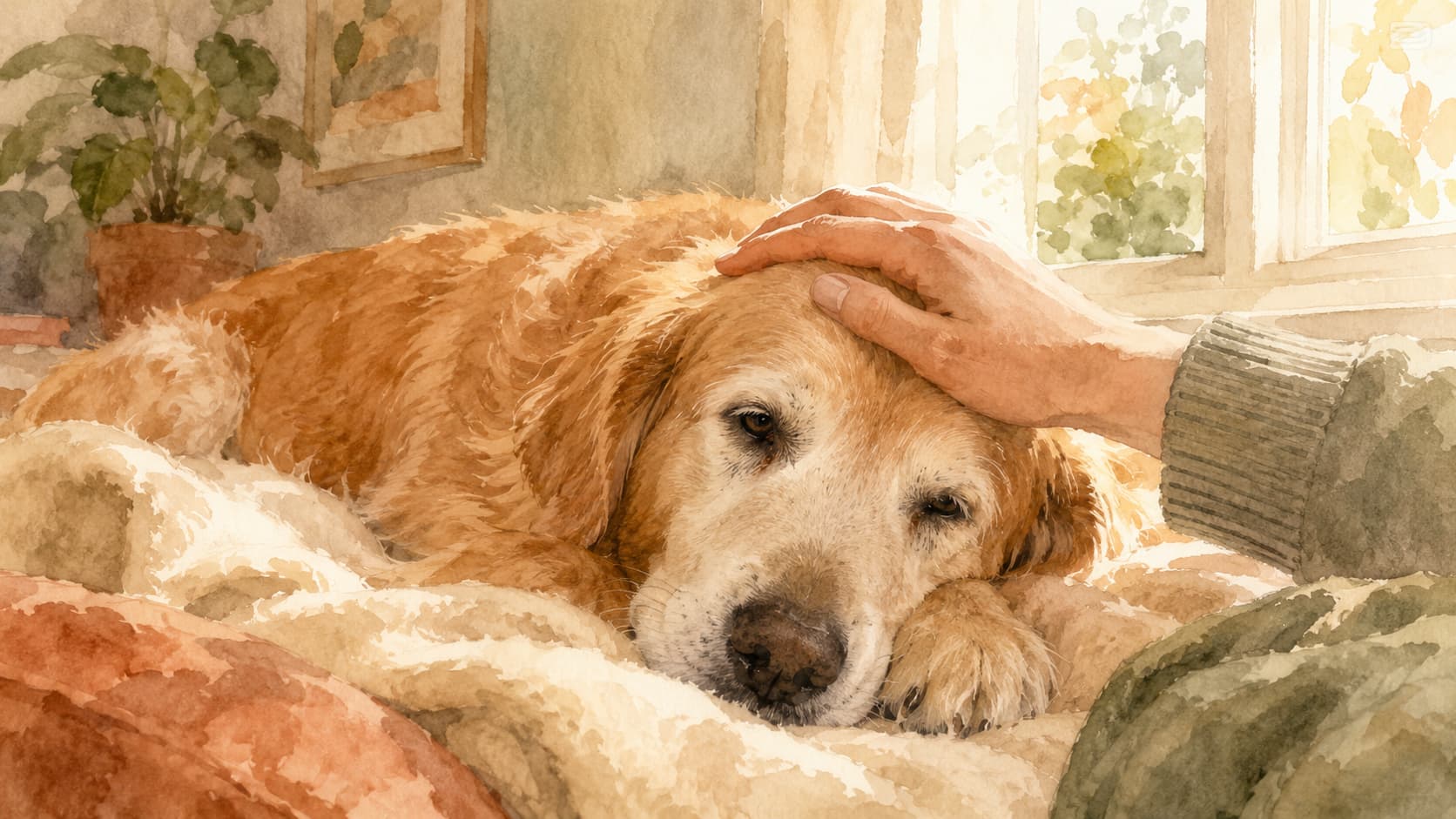
If you're reading this, something has probably already happened. A 3am wake-up that didn't make sense. A long pause at a familiar doorway. A blank stare at the wall where the food bowl used to sit. You opened a tab, typed something into Google, and ended up here. Good. You're in the right place.
Canine cognitive dysfunction (CCD) is a progressive, age-related decline in a dog's brain function, similar to Alzheimer's disease in humans. It affects up to 35% of dogs at some point in their life and typically begins between 7 and 9 years of age. Common signs include disorientation, changes in sleep–wake cycles, indoor accidents, and altered social interactions across six observable domains known as DISHAA.
Most articles about canine cognitive dysfunction read like a vet textbook with the warmth removed. They list symptoms, name the condition, throw a few supplements at you, and end. That isn't useful when it's quarter past three in the morning and your dog has been pacing since midnight.
This guide is different. It's long because the topic deserves it. It's specific because vague reassurance doesn't help. And it's written for the person sitting on the kitchen floor at 3am — not for a veterinary conference.
You'll find: what CCD actually is (and the three things it usually gets confused with), how common it really is, when it tends to start, the six DISHAA categories vets use to assess it, the early signs that almost everyone misses, what treatment actually does, and what you can do tonight without a single prescription. Sources are listed at the bottom — Cornell, AAHA, AVMA, the Dog Aging Project — so you can verify any of it.
Let's start with what you came here to find out.
What is canine cognitive dysfunction?
Canine cognitive dysfunction is a slow, age-related decline in a dog's brain function. It looks a lot like Alzheimer's in humans, and it's not a coincidence — the brain changes are similar at a cellular level. Plaques of beta-amyloid protein build up. Neurons fire less reliably. Some areas of the brain shrink. Sleep gets disorganized. Memory thins out. The dog you raised is still in there. Just harder to reach, some days.
You'll see it called several things. Vets tend to use "cognitive dysfunction syndrome" (CDS) or "canine cognitive dysfunction" (CCD). Owners often say "doggy dementia" or "dog Alzheimer's." None of these are wrong. They all describe the same condition.
What CCD is not — and this matters — is the same as ordinary aging. Old dogs slow down. They sleep more. They become a little less interested in the back garden. That's not CCD. That's just being old. The line between normal aging and clinical CCD is the line between "moves slower" and "seems lost in his own kitchen." You'll know it when you see it. Most owners do, even if they don't know what to call it yet.
It's also not the same as anxiety, pain, vision loss, or hearing loss — though all four of those frequently show up alongside it, and they sometimes look identical from across the room. We'll get into how to tell the difference further down.
How common is canine cognitive dysfunction, really?
Common enough that you should not feel alone, and not so common that every senior dog has it.
The most cited number is from Cornell University's Riney Canine Health Center: up to 35% of dogs develop signs of canine cognitive dysfunction at some point in their life. That's a wide range — the lower end of the studies sits around 14%, the upper end around 35% — but it tells you the same thing. This is not rare. If you have a dog over 8, the odds of seeing some cognitive change in their lifetime are roughly one in three.
The number climbs sharply with age. The Dog Aging Project, which is the largest single study on this so far (just over 15,000 dogs, published in Nature Scientific Reports in 2022), found that the prevalence roughly doubles for every additional year of life past 10. By the time a dog is in the 15-to-16-year window, more than two-thirds of them are showing measurable cognitive change.
So the honest answer to "how worried should I be?" depends on how old your dog is, and how long they've already been showing signs. Early notice — the kind that brings people to a guide like this — usually means you're catching it in the mild stage, when there's still real room to act.
That window is the most important thing in this whole article, and almost no one talks about it. We will.
At what age does CCD start?
Earlier than most owners expect. The first markers tend to appear between 7 and 9 years of age, depending on breed and size — and they're almost always small enough to miss the first time around.
Larger breeds age faster, biologically, so a 7-year-old Great Dane is roughly equivalent to a 10-year-old Beagle in terms of cognitive risk. If you have a giant breed, "watch from 6" is reasonable. If you have a small breed, watch from 9 or 10. If you have a mix or you don't know — just watch from 7.
What you're watching for, in those early years, is not pacing. It's something quieter than that.
It's the tiny pause at a familiar doorway. The half-second extra it takes for your dog to turn toward you when you call her name from the kitchen. It's standing in the corner facing the wall, just for a moment, before turning around like she meant to do something else. Most owners don't notice these the first ten times they happen. They notice the eleventh, when something clicks and they think wait — has she been doing that for a while?
That's the moment a guide like this becomes useful. Because what comes next — the pacing, the 3am wake-ups, the indoor accidents, the staring — those are the louder symptoms of a condition that started speaking quietly months earlier.
Catch it quiet, and you have options. We'll cover all of them.
The 6 DISHAA categories: what owners actually see
Vets quietly use a framework called DISHAA when they're sizing up a senior dog for cognitive change. The acronym stands for six observation domains. Every weird, doesn't-quite-feel-right thing you've noticed in your dog probably falls into one of them.
We'll go through each one as you'd actually experience it at home. Forget the clinical language for a minute.
D — Disorientation. Your dog gets stuck behind the couch. They face the wall like they're reading something. They approach the wrong side of a familiar door, hesitate, then back away. Confusion shows up in geography first.
I — Interactions (social). The greeting at the door has changed. Quieter. Slower. Sometimes absent. Or the opposite — they've become unusually clingy, where they used to be independent. Both are signals. The relationship feels slightly off, even if you can't always say why.
S — Sleep–wake cycles. Sleep flips. They sleep more during the day, less at night. The 3am wake-ups start. You hear pacing in the kitchen, or panting, or whining for no clear reason. Then by morning they're flat-out tired again.
H — House-soiling. Indoor accidents from a dog who hasn't had one in 11 years. Not because they can't make it outside in time — because they forgot the outdoor protocol exists. Or they pee in the wrong room and look genuinely confused about how it happened.
A — Activity changes. Less interest in walks. Less interest in their own name. The favourite toy stays in the basket. They drift through rooms instead of moving through them.
A — Anxiety & learning. Storms never bothered her before; now they do. Or they used to handle being alone for an hour and suddenly can't. New things feel scarier. Old things they once learned start to slip — the cue that always worked stops working consistently.
If you're recognising more than two or three of these, that's worth tracking. Not panicking over. Tracking.
The first signs most owners miss
We've sat across from a lot of dog owners who came in describing "the night I knew something was wrong" — usually a vivid moment. The dog standing in the bathroom looking lost. The 3am wake-up that wouldn't end. The accident on the rug after eleven years of perfect house-training.
Here's the thing: by the time those moments happen, the condition has usually been speaking quietly for six to twelve months.
What was it saying earlier? Something like:
- A two-second hesitation at a doorway your dog has used a thousand times
- Slightly slower response when you call their name from another room (and you're sure their hearing is fine)
- Standing in one corner of the kitchen for thirty seconds, then turning around as if they meant to do something else
- Looking past you when you walk into the room, instead of at you, just for a beat
- A walk where they pause and seem to need an extra moment to figure out which way is home
These are easy to dismiss. They look like nothing on any single day. They're the boring kind of clue — easy to miss precisely because they're so small.
But if you've ever found yourself thinking wait, has she been doing that for a while? — that's the moment to start writing it down. Date, time, what was happening before. Three weeks of notes will tell you more than any single dramatic incident ever could.
Want to know where your dog stands right now? Take our free 12-question DISHAA-aligned quiz. Two minutes, no account, no credit card. You'll get a structured snapshot across all six domains and a 3-night calm plan in your inbox. Start the free quiz →
The three stages of canine cognitive dysfunction
CCD doesn't have hard, agreed-upon stages the way some human conditions do. But owners and vets both find it useful to think in terms of three roughly-sketched phases. We use them not as labels but as orientation.
Mild stage. Subtle and easy to miss. A few of the small markers we listed above show up, occasionally. Your dog is mostly themselves. Sleep might be slightly disorganised. Greeting is a beat slower. The DISHAA quiz score in this range is typically in the 0–7 band. Most senior dogs sit here for a while, sometimes for years. This is where structure pays the highest dividend, because there's still so much functioning brain to anchor habits to.
Moderate stage. The signs become harder to miss. Pacing is regular. Wake-ups happen most weeks. The doorway hesitation becomes a noticeable doorway pattern. Indoor accidents start to happen, even occasionally. Recognition is slower — sometimes seemingly absent for a moment. Quiz scores tend to land in the 8–15 band. This is where most owners stop wondering and start searching. Often, this is the stage where you're reading something like this guide.
Significant to advanced. Multiple symptoms across most DISHAA domains, frequently. Sleep is fragmented. Recognition of family members may be inconsistent. Indoor accidents are routine. Quality of life conversations enter the picture. Quiz scores in the 16–36 range. This is where vet involvement is most important — for symptom management, for quality-of-life support, and for the harder conversations that come with this chapter.
The progression is rarely linear. Good days and bad days are normal. A dog can sit in moderate territory for months, slide briefly toward significant during an illness, and stabilise again. Direction over time matters more than any single week's reading.
What's actually happening in the brain
This part is short because it has to be — we're not a research lab and you're not here for a neurology lecture.
In broad strokes: as dogs age, several brain changes overlap. Plaques of a protein called beta-amyloid accumulate, particularly in regions that handle memory, attention, and behaviour. Some neurons fire less reliably. The brain shrinks slightly. Sleep regulation gets messier. The brain's ability to clear waste during sleep — which is a real, measurable function — declines.
The pattern looks remarkably like Alzheimer's in humans, which isn't a coincidence. Several research groups (including the Dog Aging Project) study CCD partly because the parallels with human dementia are biologically informative.
But here's what matters at home: this is not a moral failing of your dog, and it isn't fixable by trying harder. It is a physical condition with physical roots. Your job isn't to push back against it. Your job is to support the brain that's still there — and there's still a lot there — by lowering its workload.
That's exactly what the rest of this guide is about.
Free 2-minute DISHAA assessment
See where your dog stands across the six dimensions vets use to track cognitive change. Enter your email — we'll send your assessment and a 3-night calm plan.
Free · 2 minutes · no account · unsubscribe anytime.
CCD vs other senior conditions: what it isn't
This is one of the most useful sections of any CCD article, and the one we see most often skipped or hand-waved.
A surprising number of "CCD" symptoms have other causes that look identical from across the room. Before you assume cognitive change, run through these:
Pain. Joint pain especially. A dog with chronic stiffness or arthritis often becomes restless in the evening, vocalises at night, paces because lying down hurts, and seems to "withdraw" — except it's pain, not cognition. The DISHAA framework can't tell you the difference. Your vet's hands-on exam can.
Hearing loss. Slow response to their name? It might not be cognitive — it might just be that they didn't hear you. Try standing in their line of sight and gesturing. If response returns, hearing is the variable, not the brain.
Vision changes. Standing in odd spots. Bumping into furniture. Hesitating at the top of stairs. These read like disorientation but are often vision. A vet can do a basic eye exam in two minutes that rules a lot in or out.
Endocrine and metabolic conditions. Hypothyroidism, Cushing's, kidney issues — all of these can produce behavioural changes that mimic CCD. Bloodwork rules them in or out.
Brain tumours, neurological events. Less common but not rare in senior dogs. Sudden onset of disorientation, head tilt, or circling deserves a vet visit, not a self-assessment.
The honest version of "is this CCD?" is "we don't know yet — and we won't until other things are ruled out." That's not a failure. That's the responsible answer.
How CCD is diagnosed
There is no single CCD test. There's no blood marker, no scan that lights up. Diagnosis is what vets call a clinical diagnosis — built from history, observation, and ruling out alternatives.
In late 2025, a working group of veterinary researchers published the first international consensus guidelines for CCD diagnosis in JAVMA (the Journal of the American Veterinary Medical Association). The framework they recommend includes:
- A structured behavioural history from the owner — patterns over weeks or months, not single incidents
- A validated questionnaire like DISHAA or CADES (these are scoring tools, not diagnostic tests)
- A physical exam to rule out pain, sensory loss, and orthopaedic issues
- Bloodwork and basic diagnostics to rule out metabolic conditions
- Sometimes imaging, in cases where neurological causes need to be excluded
Notice what's at the top of that list: the owner's history. Not technology. Not a scan. The most important diagnostic input is what you've been observing at home for the last few months. That's why we keep saying: write things down. Your notes are the actual diagnostic tool. We give you a structured way to take them — and that's a real reason to bring our DISHAA quiz log to your next appointment.
What your vet handles, what Hearthside handles
Senior dog care has two clear sides. They're complementary, not in competition — and most of what actually changes a dog's senior years comes from running both at the same time.
Your vet's side is medical. Bloodwork. Diagnosis. Prescription decisions. Dietary recommendations. Supplement guidance. Ruling out conditions that mimic CCD. Monitoring response over time. We stay deliberately out of that side, because the right choice for your dog depends on bloodwork, comorbidities, current medications, and clinical judgement we don't have access to. Your vet does.
Our side is everything that happens at home between appointments. That's the daily rhythm — and it's where most of senior dog care actually plays out. It's also where most owners feel completely on their own, because the vet visit lasts twenty minutes and the rest of the week is yours to figure out.
The Hearthside Method is the structured eight-week version of that home work. It's the part of senior dog care nobody hands you when CCD enters the conversation, and it covers:
- A progressive weekly plan that introduces one supportive change at a time — never overwhelming, always building
- The full DISHAA observation framework with printable worksheets, so you can score and track changes month over month
- A complete calming evening routine — the dusk-to-bedtime ritual sundowning-affected dogs respond to most
- Mobility-aware morning routines and post-walk recovery structures for stiffness and joint comfort
- Sleep support strategies for the domain most CCD-affected dogs struggle with hardest
- Cognitive engagement activities built for aging brains — sniff work, scatter-feeding, gentle puzzles that match what a senior dog can still do
- Sundowning-aware structure for the hardest evening hours
- Owner reflection sheets you return to weekly, so the work compounds instead of evaporating
- Quality-of-life weekly check-ins you'll keep using long after week eight ends
- Vet conversation templates — one component among many, not the whole point
The Method runs alongside your vet's medical care, not after it and not instead of it. If your dog is on prescription support, the Method gives the daily rhythm any treatment needs to actually land. If your dog isn't on anything yet, the Method gives you a structured way to start working with what's happening — without a single prescription — and it creates the documented observation history that makes any future vet conversation specific and actionable.
This is the seam most owners fall through. You leave the vet visit with a recommendation or a wait-and-see. Then you go home and nobody has told you what to actually do on Tuesday night when your dog won't settle. That's what Hearthside is built for. Eight weeks. Ready in your inbox the moment you check out.
See what's inside the Hearthside Method →
What you can do at home: the real Hearthside scope
Now we're in our lane. This is what we know about, and this is where the work pays off.
Three categories matter most:
Environment. Aging brains struggle more in chaotic, unpredictable, noisy, or dark environments. The fixes are concrete. Add nightlights to hallways and the path between bedroom and water bowl. Don't rearrange the furniture. Keep the route to the back door clear and unchanged. Reduce sudden sounds in the evening. Predictability is a brain support, not a luxury.
Routine. A senior dog with CCD does noticeably better on three to five reliable daily anchors than on a strict timetable. Anchors are things like: the morning walk happens after coffee, dinner is at the same hour, the wind-down begins when the lights dim, and the last walk is the same loop. The brain gets to use less working memory because the day rhymes with the day before.
Structure for the hardest hour. For most CCD-affected dogs, the hardest hour is between dusk and bedtime. The light shifts, household noise winds down, and the dog's circadian regulation is the thing most affected by CCD. A pre-built evening routine — dim lights an hour before bed, a short sniff walk after dinner, a slow chew, a settled spot near you — can make that hour go from chaotic to navigable. Most dogs respond to that structure faster than to any single intervention you could try alone.
The full version of all three is what the Hearthside Method gives you, structured across eight weeks. But you can start tonight without it. Lower the lights at 8pm. Walk the same route. Sit nearby without engaging much. See what shifts in three nights. Nothing about that requires a purchase.
Sundowning: why evenings get harder
If your dog is calm during the day and unrecognisable from dusk onward, you're describing sundowning — the same pattern people sometimes recognise from human dementia. It's not a separate condition from CCD; it's a specific time-of-day expression of it.
The mechanism is partly about circadian rhythm disruption (which CCD directly affects) and partly about cumulative cognitive fatigue across the day. By 6pm, the brain has been working all day on a slightly diminished battery, and the buffer is gone.
We've written a separate guide on this, because the dusk-to-bedtime routine deserves its own walkthrough: Sundowning in dogs →.
Life expectancy with CCD: the honest version
CCD itself rarely shortens lifespan dramatically. It is a quality-of-life condition more than a survival condition. Many dogs with mild to moderate CCD live their normal expected lifespan, with the condition managed and supported.
What changes is the texture of the senior years. Without intervention, the cognitive decline tends to accelerate over 12–24 months. With consistent environmental support, structured routine, and appropriate vet involvement, that trajectory is often slower and steadier.
We don't promise outcomes. We can't. Every dog ages differently. What we can say is that the owners we hear from who started early — at the first quiet signals, not the first loud ones — almost always describe a longer, calmer chapter than they'd been bracing themselves for.
Quality of life: the harder conversation
At some point in this chapter, the question of quality of life comes up. Not necessarily soon. But eventually, with most senior dogs, there's a conversation about it.
We don't push toward an answer. We push toward a framework that lets you ask honestly.
Five dimensions are worth scoring weekly, on a 1–10 scale, in a notebook only you see: mobility, appetite and hydration, hygiene (whether they can keep themselves clean), mental engagement (do they still respond to the things they used to enjoy), and moments of genuine joy (real ones, not wishful ones). The absolute number per week matters less than the direction over weeks.
Slow declines deserve attention. Slow recoveries — sometimes a dog stabilises after months — also deserve attention. Most owners can't see the trend in real time without writing it down. That's what the framework is for.
If quality-of-life conversations need to happen with your vet, bring the framework. It changes that conversation from a vague gut feeling to a dated, scored record across weeks — and it makes the next steps, whatever they are, feel less arbitrary.
A 3-step action plan for tonight, this week, this month
If you've read this far, you have enough to start. Here's what we'd do, in order.
Tonight. Lower the lights at 8pm. Walk the same loop you walked yesterday. Sit nearby without engaging much. Don't try to fix anything. Just notice. Note the time your dog finally settled, and how many wake-ups happened overnight.
This week. Take the free DISHAA quiz. Twelve questions, two minutes. You'll get a baseline score across all six domains and a 3-night calm plan in your inbox. Repeat the quiz next week and compare. Patterns emerge faster than you'd expect.
This month. Two things in parallel.
First, make one appointment with your vet, with three weeks of DISHAA observations in hand. Don't go in with a question. Go in with data. Ask: what does this pattern suggest, what should we rule out first, and what would you want to see at the next visit. The medical side of senior care happens here.
Second, start the home side. The Hearthside Method is the structured eight-week framework for everything that happens between vet visits — the evening routine, sleep support, mobility work, cognitive engagement, sundowning structure, weekly observation, quality-of-life monitoring. One small supportive change per week, building over eight weeks into a complete daily rhythm. Most owners we hear from describe the home side as the part they wished someone had handed them on day one.
The two sides run in parallel, not in sequence. You don't need to wait for the vet visit to start the home work, and the home work makes the vet conversation more specific when it happens.
This chapter is hard. It is also navigable. The dog you've loved your whole life is still in there — and the work of these months is mostly about giving them a quieter, steadier place to be while they're still here.
Start the Hearthside Method → · Take the free quiz first →
Frequently asked questions
Common questions dog owners ask about this. We answer plainly and stay in our lane.
What are the first signs of canine cognitive dysfunction?+
Earliest signs are quiet, not dramatic. A small hesitation at a familiar doorway. A slightly slower response to their own name. Standing in a corner for half a minute and turning around as if they forgot what they were doing. Most owners notice the louder symptoms (pacing, 3am wake-ups, indoor accidents) months after the quiet ones started. If you're catching it at the quiet stage, you have the most options.
At what age does canine cognitive dysfunction start?+
First markers usually appear between 7 and 9 years of age, depending on breed size. Larger breeds age faster biologically, so a 7-year-old Great Dane is in roughly the same risk zone as a 10-year-old Beagle. Prevalence rises sharply with age — research from the Dog Aging Project (Nature, 2022) shows the rate roughly doubles for every additional year past 10.
Is canine cognitive dysfunction the same as dog dementia?+
Yes — they're the same condition under different names. You'll see CCD, CDS (cognitive dysfunction syndrome), doggy dementia, and dog Alzheimer's used interchangeably. The clinical name vets prefer is canine cognitive dysfunction.
Can CCD be cured or reversed?+
No. CCD is a progressive condition — it does not reverse. What can change is the rate of progression and the day-to-day quality of life. Early environmental support, consistent routine, and appropriate vet involvement are associated with slower, steadier progression in many dogs. We make no promises of outcomes — every dog ages differently.
What can I give my senior dog for cognitive symptoms?+
Medical decisions — prescription medications, dietary approaches, evidence-supported supplements — sit with your veterinarian, because the right combination depends on bloodwork, current medications, and conditions we don't have access to. On the home side, where we work, the answer is structured daily care: a predictable evening routine, sleep support, mobility-aware mornings, cognitive engagement built for aging brains, and weekly observation. That's what the eight-week Hearthside Method delivers, and it runs alongside whatever your vet recommends. Most senior dogs benefit from both sides at the same time.
How is canine cognitive dysfunction diagnosed?+
There is no single CCD test. Diagnosis is clinical — built from a structured behavioural history (your observations over weeks), a validated questionnaire like DISHAA or CADES, a physical exam to rule out pain and sensory issues, and bloodwork to rule out metabolic conditions. Imaging is sometimes added when neurological causes need to be excluded. The 2026 JAVMA consensus guidelines describe this in detail.
What is the DISHAA assessment?+
DISHAA is a six-domain framework veterinary behaviorists use to observe cognitive change in senior dogs. Each letter is a category: Disorientation, social Interactions, Sleep–wake cycles, House-soiling, Activity changes, and Anxiety. It's an observation tool, not a diagnostic test. Our free 12-question quiz walks you through all six domains and gives you a baseline you can track over time.
Sources
Authoritative references underlying this guide. Linked for verification.
- Cognitive Dysfunction SyndromeCornell University Riney Canine Health Center
- Managing Cognitive Dysfunction and Behavioral Anxiety (2023 Senior Care Guidelines)American Animal Hospital Association
- CCDS Working Group: Guidelines for diagnosis and monitoring (2026)Journal of the American Veterinary Medical Association
- New diagnostic tools for identifying early stages of canine dementiaAmerican Veterinary Medical Association
- Evaluation of cognitive function in the Dog Aging Project (n=15,019)Nature Scientific Reports, 2022
- Physical signs of canine cognitive dysfunctionPMC / National Institutes of Health (Schütt et al)
- Updates on Cognitive Dysfunction Syndrome (Jan/Feb 2025)Today's Veterinary Practice
Tom writes Hearthside's long-form guides on senior dog cognitive change and home-care frameworks. He's spent years living alongside aging dogs, and that perspective shapes every guide — alongside the veterinary research we cite.
Free 2-minute DISHAA assessment
See where your dog stands across the six dimensions vets use to track cognitive change. Enter your email — we'll send your assessment and a 3-night calm plan.
Free · 2 minutes · no account · unsubscribe anytime.
The 8-week Hearthside Method
A structured plan for the dog you've loved your whole life.
Discover the Method