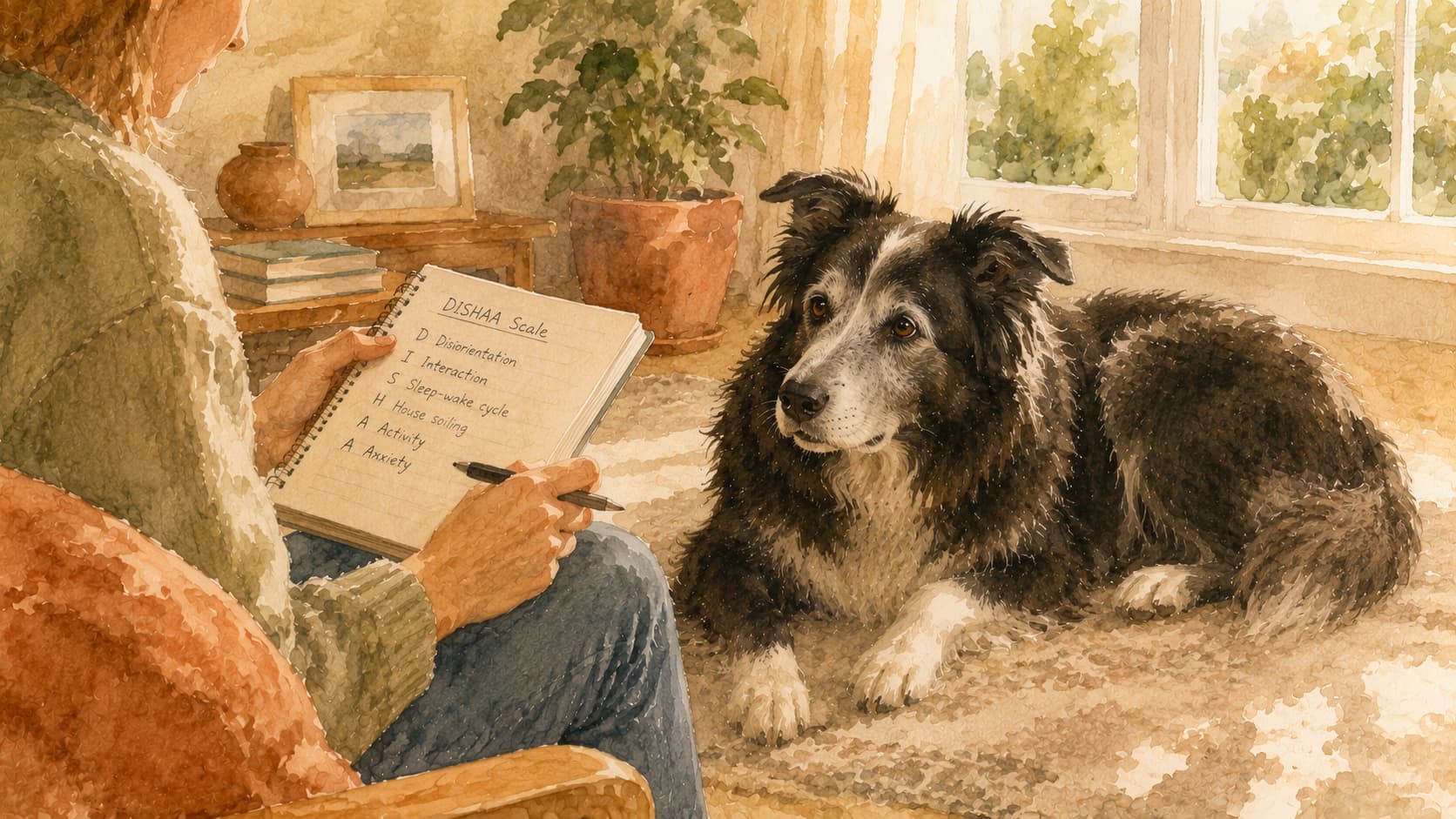
Your vet probably hasn't handed you a DISHAA worksheet. Most don't, unless they're behaviour-focused or your dog's situation has already escalated. But it's the framework they're often using in their head while they ask you questions. Knowing it before your appointment changes the whole conversation. This guide walks you through it without the clinical filter.
The DISHAA scale is a six-domain observation framework veterinarians use to assess cognitive change in senior dogs. The acronym stands for Disorientation, social Interactions, Sleep–wake cycles, House-soiling, Activity changes, and Anxiety. Each domain is scored on a 0–3 frequency scale (never, rarely, sometimes, often). Total scores range 0–36 and indicate severity bands from mild to advanced cognitive change.
Most articles about DISHAA either link to a Purina PDF and call it a day, or get so technical that the only readers who finish are vets. Neither helps a dog owner trying to figure out whether what they're seeing is something to act on.
We're going to fix that. By the end, you'll know what each letter stands for, how the scoring actually works, what a particular score means at home, and what to do with the answer.
What is the DISHAA scale, plainly?
DISHAA is an acronym for six observation domains that show up in dogs as their brains age. It was developed for veterinary use as a structured way to ask owners about behavioural change — instead of relying on a vague "is anything different?" question that's almost impossible to answer well.
The six domains are: Disorientation, social Interactions, Sleep–wake cycles, House-soiling, Activity changes, and Anxiety. The framework gives each domain a small set of questions, and the owner scores each on a frequency scale (never / rarely / sometimes / often). The total score, and the pattern across domains, gives the vet a structured picture.
Two things to understand up front:
DISHAA is an observation tool, not a diagnostic test. It doesn't tell you your dog has canine cognitive dysfunction. It tells you which categories of behaviour have shifted, by how much, and in what direction.
DISHAA is not the only such tool. Vets sometimes use CADES (a longer, more clinical questionnaire) or CCDR (Canine Cognitive Dysfunction Rating scale). DISHAA is the most owner-friendly and the most widely used in everyday practice, which is why we built our quiz around it.
The six DISHAA categories — what they actually look like
Here's each letter, paired with the kinds of things owners actually describe when they're noticing it. We've kept the examples concrete because that's what makes a framework usable.
D — Disorientation. Standing in corners or behind furniture looking lost. Approaching the wrong side of a familiar door. Staring at walls for long stretches. Getting "stuck" in spots the dog has navigated for years without thinking.
I — Interactions (social). Quieter greetings, slower recognition of family. Or the opposite — sudden clinginess where there used to be independence. A change in how your dog relates to you, specifically, is one of the most telling signals.
S — Sleep–wake cycles. Sleeping more during the day, less at night. Wake-ups between 1 AM and 5 AM that didn't happen before. Pacing, vocalising, or restlessness in the evening hours. This is often the loudest, hardest-to-ignore domain.
H — House-soiling. Indoor accidents in a house-trained dog, with no obvious medical explanation. Peeing in the wrong room. Forgetting the outdoor protocol exists. Confusion about what the back door is for.
A — Activity changes. Less interest in walks, play, or sniffing. Slower response (or no response) to their own name when hearing is intact. A drift through the day instead of a movement through it.
A — Anxiety & learning. New fears that didn't used to register. Reluctance with small environmental changes (a moved water bowl, rearranged furniture). Difficulty adjusting to a different walking schedule. A general sense that the dog's resilience to small daily friction has dropped.
If you recognise things across multiple domains, that's a more meaningful signal than a lot of activity in one. CCD tends to show up across domains, not in just one.
How the scoring actually works
The clinical DISHAA tool uses a 0–3 scale per question:
- 0 — Never: hasn't happened in the past four weeks
- 1 — Rarely: less than once a week
- 2 — Sometimes: one to three times a week
- 3 — Often: multiple times a week, or daily
Multiple questions per domain get scored, then totals add up. Our free 12-question quiz uses the same scoring — two questions per domain, max score 36.
Higher scores point toward more cognitive change, more frequently. But the absolute number matters less than two other things: the pattern across domains (is it concentrated in sleep, or spread across all six?), and the direction over time (is the score climbing month over month, or stable?).
That second one is the one most articles skip. A single DISHAA score is a snapshot. A series of DISHAA scores is a trend. The trend tells you far more than any single reading.
What your DISHAA score means
We use four rough bands. These are guideposts, not diagnoses.
Mild (0–7) — Early signals worth watching. Most dogs aged 8+ score somewhere in this range. A handful of behaviours, occurring rarely, are part of normal senior life. The recommendation here is observational: stay alert, run the quiz again in a month, write down what you notice. No intervention needed unless something changes.
Moderate (8–15) — Active observation, structure pays off. You're seeing real, recurring patterns. This is consistent with early to mid-stage cognitive change. The most useful thing you can do at this stage is introduce predictable structure — a consistent evening routine, a regular sleep environment, simple daily anchors. The kind of thing the Hearthside Method walks you through over eight weeks.
Significant (16–24) — Vet conversation needed alongside structured support. Behaviours show up across multiple domains, frequently. This score warrants a dedicated veterinary conversation about cognitive change — bring your observation log. At home, the goals shift to comfort, environment, and routine stabilisation.
Advanced (25–36) — Vet involvement essential, supportive care priority. Significant cognitive signs across most domains. The home environment and routine become major contributors to quality of life. Quality-of-life conversations with your vet enter the picture.
Want to see where your dog lands? Our free DISHAA quiz takes about two minutes and gives you a score across all six domains plus a 3-night calm plan in your inbox. No account, no payment. Take the free quiz →
Free 2-minute DISHAA assessment
See where your dog stands across the six dimensions vets use to track cognitive change. Enter your email — we'll send your assessment and a 3-night calm plan.
Free · 2 minutes · no account · unsubscribe anytime.
How often should you re-take it
Monthly is plenty. Weekly is too often — you're measuring noise instead of signal. Quarterly is fine if your dog is in the mild band and stable. If you've recently introduced a change (new routine, vet medication, environmental shift), wait three to four weeks before re-scoring so the change has time to register.
We recommend saving each score and the date in a single document or notebook. Three or four readings across a few months is when patterns become visible.
DISHAA vs CADES vs CCDR
You'll occasionally see other scales mentioned. Short version of what's different:
CADES (Canine Dementia Scale) is more detailed — 17 items across four severity levels. It's used more in research settings and behavioural specialty practices. Heavier to fill out, but more granular.
CCDR (Canine Cognitive Dysfunction Rating Scale) is older and uses a 1–5 scale per item. It's been used in some prevalence studies.
For most owners, DISHAA is the right balance: detailed enough to be informative, short enough to actually complete and re-take regularly. If your vet specifically asks for CADES, ask whether it's because they want more detail than DISHAA can give — and use both as a pair.
What to do with your DISHAA score
This is the part most owner-facing articles forget. Knowing your score is only useful if you do something with it.
At any score, write it down with the date. Even a 4 is worth recording, because in six months you'll want to know whether it stayed at 4 or moved.
At moderate (8+), two practical actions are worth taking. First, introduce environmental support — a more predictable evening routine, simpler home layout, consistent feeding window. Second, mention the score and your observations at your next regular vet visit, even if you're not making a special appointment for it.
At significant (16+), make a dedicated appointment. Bring three to four weeks of DISHAA observations, ideally with notes about what was happening when each behaviour occurred. The vet will probably want to rule out pain, hearing, vision, and metabolic causes before settling on cognitive dysfunction as the explanation. That's appropriate — those overlap a lot with CCD symptoms.
At advanced (25+), the conversation expands beyond cognitive support to include quality-of-life monitoring. Your vet has options at this stage. The home work becomes more about comfort and steady routine than about slowing progression.
How to use DISHAA with your vet
Three practical things to bring to any vet appointment where cognitive change is on the table:
- Your most recent DISHAA score, with the date you took it
- At least one prior score (a month or more earlier), so the trend is visible
- A short list of specific incidents, dated — "Friday 11pm, paced for 90 minutes after dinner" beats "she paces a lot lately"
Your vet's job is the differential. They need to rule out conditions that mimic CCD — joint pain, vision changes, hearing loss, metabolic issues — before settling on cognitive dysfunction. Your structured observations make that process faster and more accurate.
Walk in with data. Walk out with a plan.
Frequently asked questions
Common questions dog owners ask about this. We answer plainly and stay in our lane.
What does DISHAA stand for?+
Disorientation, social Interactions, Sleep–wake cycles, House-soiling, Activity changes, and Anxiety. The double-A reflects two distinct behavioural domains (activity and anxiety) that both matter independently in cognitive assessment.
Is the DISHAA scale a diagnosis for canine cognitive dysfunction?+
No. DISHAA is an observation framework, not a diagnostic test. It structures what you and your vet observe across six domains. Diagnosis still requires a veterinary exam and rules out other conditions like pain, hearing loss, vision changes, and metabolic issues.
Where can I find a DISHAA questionnaire?+
Our free 12-question DISHAA-aligned quiz is at /quiz — takes two minutes, no account needed. The full clinical Purina DISHAA worksheet is also published online but is denser and built for vet use rather than owner self-assessment.
How often should I re-take the DISHAA quiz?+
Monthly is plenty for most senior dogs. Weekly is too often — you're measuring noise. Quarterly works if your dog is in the mild band and stable. Save each score with the date so the trend over time is visible.
What's the difference between DISHAA and CADES?+
CADES (the Canine Dementia Scale) is longer and more granular — 17 items across four severity levels. It's used more in research and specialty behavioural practices. DISHAA is shorter, owner-friendly, and the standard for everyday clinical use. For most owners, DISHAA is the right balance.
My dog scored in the moderate band. What do I do?+
Two things. First, introduce environmental support — a predictable evening routine, consistent feeding window, simple home layout. Second, mention the score and observations at your next regular vet visit. Bring at least one prior score so the trend is visible.
Sources
Authoritative references underlying this guide. Linked for verification.
- Canine Cognitive Dysfunction Syndrome — DISHAA assessment toolPurina Institute
- CCDS Working Group: Guidelines for diagnosis and monitoring (2026)Journal of the American Veterinary Medical Association
- Cognitive Dysfunction SyndromeCornell University Riney Canine Health Center
- Updates on Cognitive Dysfunction Syndrome (Jan/Feb 2025)Today's Veterinary Practice



Sara reviews the veterinary literature behind Hearthside's content and ensures every claim links back to a citable source. Her focus areas: the DISHAA framework, sundowning patterns, and sleep–wake dysregulation in aging dogs.
Free 2-minute DISHAA assessment
See where your dog stands across the six dimensions vets use to track cognitive change. Enter your email — we'll send your assessment and a 3-night calm plan.
Free · 2 minutes · no account · unsubscribe anytime.
The 8-week Hearthside Method
A structured plan for the dog you've loved your whole life.
Discover the Method