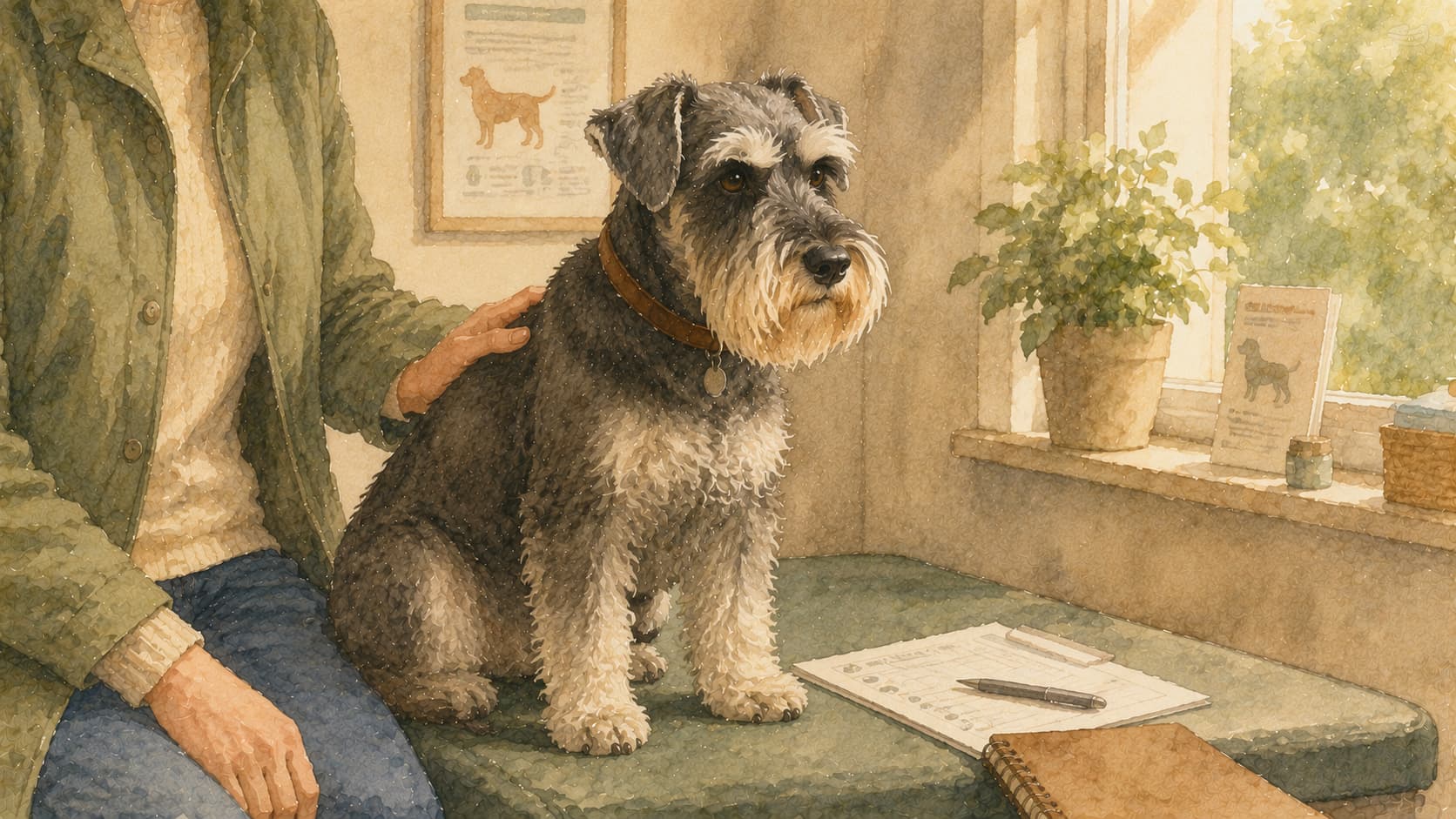
A senior dog vet visit lasts about twenty minutes. In that window, you're trying to communicate weeks or months of subtle changes — pacing patterns, sleep shifts, the doorway hesitation, the night you couldn't get her to settle until 2 AM. Without preparation, half of it never makes it into the conversation. With preparation, those twenty minutes change the next three months.
Preparing for a senior dog vet visit requires three weeks of structured observations, a one-page summary, a full medication list, and your top three concerns in priority order. Bring dated logs of sleep, appetite, mobility, behaviour, and toileting. Ask about the differential (what to rule out first), the timeline, and how to identify worsening versus stable trajectories. Take notes or record with permission.
Most vet visit prep articles tell you to "make a list." That's true but not quite enough. The list is the easy part. The structure — what kind of list, organised how, with what supporting observations — is what makes the difference between a vet who's guessing and a vet who has something specific to work with.
This guide walks you through how to prepare a senior dog vet appointment that's worth the time you spend driving there.
Three weeks of observations beats anything else you bring
The single most valuable thing you can hand your vet is a structured log of what's been happening at home. Not a list of symptoms — a log, dated, with times and context.
Three weeks is the sweet spot. Less than that and you don't have enough to see patterns. More than that and the dataset becomes hard to summarise in a 20-minute visit.
Track:
- Sleep: bedtime, number of wake-ups, time finally slept through, anything notable during wake-ups
- Appetite: meals eaten, meals skipped, any changes in enthusiasm or speed
- Mobility: stiffness on rising, difficulty with stairs, any limping, post-walk recovery
- Behaviour: pacing windows, confusion episodes, social changes, restless evenings
- Toileting: any indoor accidents, frequency of outdoor toileting, anything unusual
- Anything new: new sounds bothering them, new spots they're avoiding, new clinginess
Most owners over-rely on memory. The notebook is honest in a way memory isn't.
Our free DISHAA quiz gives you a structured starting point — a 12-question scan that scores cognitive change across six domains. Taking it once before your appointment and including the score in your notes gives your vet a baseline they can re-measure against in three months.
The night-before checklist
The day before the appointment, prepare the following:
A one-page summary of the three weeks. Most vets prefer a single sheet over a stack of nightly logs. Summarise patterns rather than incidents. ("Pacing started most nights between 9 and 11 PM in weeks 2 and 3, with average settling around midnight.") The detailed logs come along as backup if your vet wants to dig in.
A list of all current medications and supplements, including doses. Vets often discover incidental drug interactions during senior visits. The list saves diagnostic time.
Recent food, including any changes. New food, new treats, new chews — anything introduced in the last few months.
Your top three concerns, in priority order. The visit may not get to all three. If it doesn't, you want the most important one covered first.
Two videos, if any of the behaviours are intermittent. A 30-second clip of nighttime pacing or a confused doorway moment communicates more than any verbal description.
Five questions worth asking
The visit will go where your vet leads it, but five questions are almost always worth raising explicitly.
1. "What conditions are worth ruling out before we land on a diagnosis?" This invites the differential conversation. For senior cognitive or behavioural changes, the differential usually includes pain, sensory loss, metabolic conditions, and orthopaedic issues. Hearing the differential out loud helps you understand what's still open.
2. "What would you want to see at the next visit to know whether what we're trying is working?" This sets up a feedback loop. It also gives you specific things to track between now and then.
3. "What's the timeline you're thinking?" Whether the next step is bloodwork, a medication trial, monitoring, or a referral, asking about timeline helps you know what to expect and when to come back.
4. "How would I know if this is getting worse versus stable?" This is the question most owners forget. Knowing what trajectory looks like — what changes would be concerning, what changes would be normal progression — helps you read what's happening at home between visits.
5. "Is pain a part of this picture?" Pain is the most under-recognised contributor to senior dog behaviour change. Asking about it explicitly often opens a useful sub-conversation.
Free 2-minute DISHAA assessment
See where your dog stands across the six dimensions vets use to track cognitive change. Enter your email — we'll send your assessment and a 3-night calm plan.
Free · 2 minutes · no account · unsubscribe anytime.
What to do during the appointment
Take notes or record (with permission). Most senior dog vet visits cover a lot of ground, and you'll forget pieces by the time you're in the car. Ask your vet if they're comfortable with a recording on your phone — most are, especially in routine senior care conversations.
Don't apologise for the list. Some owners feel they're being demanding by arriving with a structured set of observations. The opposite is true. Vets who work with senior dogs uniformly prefer prepared owners.
Ask one clarifying question at a time. When your vet recommends something, ask one specific thing about it before they move on. Compound questions tend to get one answer.
Get the next steps in writing. Either ask for them at checkout, or write them down before you leave the room. Half of vet-visit confusion happens between the appointment ending and you getting home.
After the visit
Two things to do within 48 hours:
Re-read your notes and the recommendations. Things often make more sense once you're home and decompressed. If anything is unclear, call back — most vets are happy to clarify on the phone.
Update your DISHAA log with the date and the outcome. "Visit Oct 15, recommended pain trial for 4 weeks, recheck Nov 15." This gives you a structured timeline you can hand back to the vet at the next visit.
What we add on the home side
Vet visits handle the medical decisions. Your daily structure handles everything else — and the two together are what most senior dogs respond to.
The Hearthside Method is the structured eight-week at-home framework that complements vet care: progressive daily rhythm, DISHAA observation worksheets you fill in alongside the medical work, calming evening routines, mobility-aware mornings, cognitive engagement, sleep support, and weekly quality-of-life check-ins. It also includes printable vet-visit prep templates that build exactly the kind of structured log we described above.
Most owners we hear from describe the Method as the part of senior care nobody else handed them — the daily rhythm work that runs alongside the medical care, neither subordinate to it nor a replacement for it.
You can prep your next vet visit with what's in this guide alone. You can also prep with the structured templates the Method provides. Either way, you'll walk in with more than most senior dog owners do — and that changes the appointment completely.
Frequently asked questions
Common questions dog owners ask about this. We answer plainly and stay in our lane.
What should I bring to a senior dog vet appointment?+
A one-page summary of three weeks of observations (sleep, appetite, mobility, behaviour, toileting), a full list of current medications and supplements with doses, recent food changes, your top three concerns in priority order, and 1–2 short videos if any behaviours are intermittent. Notes beat memory.
How long should I observe my senior dog before a vet visit?+
Three weeks is the sweet spot. Less than that and patterns aren't visible. More than that and the dataset becomes too dense to summarise in a 20-minute appointment. Three weeks gives enough data to see what's recurring versus what's incidental.
What questions should I ask my vet about my senior dog?+
Five worth raising: what conditions are worth ruling out first, what they'd want to see at the next visit to know whether interventions are working, what timeline they're thinking, how to tell whether things are getting worse versus stable, and whether pain is part of the picture. Pain is the most under-recognised contributor to senior dog behavioural change.
Should I take notes during the vet visit?+
Yes — or record with permission. Most senior dog vet visits cover a lot of ground, and you'll forget pieces by the time you're in the car. A recording on your phone (with the vet's consent, which most give freely) means you can revisit the conversation when you're decompressed.
What's a DISHAA observation log and why bring it to the vet?+
DISHAA is the six-domain framework vets use to assess cognitive change in senior dogs. An observation log scored over a few weeks gives your vet a structured baseline they can re-measure against next visit. We have a free 12-question DISHAA quiz at /quiz that produces exactly this kind of dated, scored baseline.
What should I do after the vet visit?+
Within 48 hours, re-read your notes and the recommendations — things often make more sense after you've decompressed. If anything is unclear, call back; most vets clarify on the phone. Then update your observation log with the date and the outcome so you have a structured timeline to bring to the next visit.
Sources
Authoritative references underlying this guide. Linked for verification.
- Managing Cognitive Dysfunction and Behavioral Anxiety (2023 Senior Care Guidelines)American Animal Hospital Association
- Cognitive Dysfunction SyndromeCornell University Riney Canine Health Center
- CCDS Working Group: Guidelines for diagnosis and monitoring (2026)Journal of the American Veterinary Medical Association
Sara reviews the veterinary literature behind Hearthside's content and ensures every claim links back to a citable source. Her focus areas: the DISHAA framework, sundowning patterns, and sleep–wake dysregulation in aging dogs.
Free 2-minute DISHAA assessment
See where your dog stands across the six dimensions vets use to track cognitive change. Enter your email — we'll send your assessment and a 3-night calm plan.
Free · 2 minutes · no account · unsubscribe anytime.
The 8-week Hearthside Method
A structured plan for the dog you've loved your whole life.
Discover the Method