There's a difference between a schedule and a rhythm. A schedule is what we put on a calendar — rigid, hour-by-hour, fragile when life gets in the way. A rhythm is what an aging dog's brain actually responds to: a small number of reliable anchors that recur in roughly the same order, day after day. The work of building a senior dog routine isn't about precision. It's about predictability.
A senior dog's daily routine works best as five consistent anchors in a predictable order, rather than a strict schedule. The five anchors are: a wake-up sequence, a morning walk on a consistent loop, two predictable mealtimes (with dinner by 5:30–6 PM), an evening sniff walk, and a wind-down sequence in the two hours before bed. Same shape every day, with clock times flexible by 30–60 minutes.
Most senior dog routine articles read like a hospital schedule — 7:00 AM walk, 7:30 breakfast, 11:00 nap, 2:00 PM second walk. That's not what aging dogs need, and it's not what most owners can sustain. What works is something looser and more durable: a handful of consistent anchors, in a predictable order, with the time-of-day flexible enough to survive real life.
This guide walks through what those anchors are, why they matter so much in senior years specifically, and how to build them gradually without overwhelming yourself or your dog.
Why senior dogs respond so strongly to predictability
Two things change in the aging dog brain that make routine matter more, not less.
First, working memory and attention narrow. A younger dog can flexibly adjust to a different schedule, a new walking route, a delayed dinner. A senior dog has less cognitive headroom to absorb variability. What was a minor adjustment at age 4 becomes a destabilising disruption at age 12.
Second, predictable environmental cues do more of the work. As the brain's own scheduling signals get noisier with age, external rhythms — the dimming of light at dusk, the sound of dinner being prepared, the leash coming off the hook — become more important. The dog's brain leans on the environment to know what comes next.
Routine, for a senior dog, isn't restriction. It's support. The brain stops working as hard because the day rhymes with the day before.
The five anchors most senior dogs benefit from
You don't need fifteen routine elements. You need five reliable ones, in a consistent order.
1. The wake-up moment. Not a specific time — a specific sequence. You getting out of bed, opening curtains, putting the kettle on (or whatever your morning has been for years), then attention to the dog. This sequence is your dog's anchor that the day is starting. The clock time can flex; the sequence shouldn't.
2. The morning walk. Same loop. Twenty to forty minutes depending on your dog's mobility. Same general window in the morning — within an hour or so of a consistent time is plenty. The walk gives the body its morning movement and the brain its "we are now in the active part of the day" cue.
3. Two reliable mealtimes. Breakfast and dinner, in consistent windows. Earlier dinner (by 5:30–6 PM) is significantly better than later for senior dogs — late meals push digestion into night-time and contribute to sleep disruption. Same food bowl, same spot, same general time.
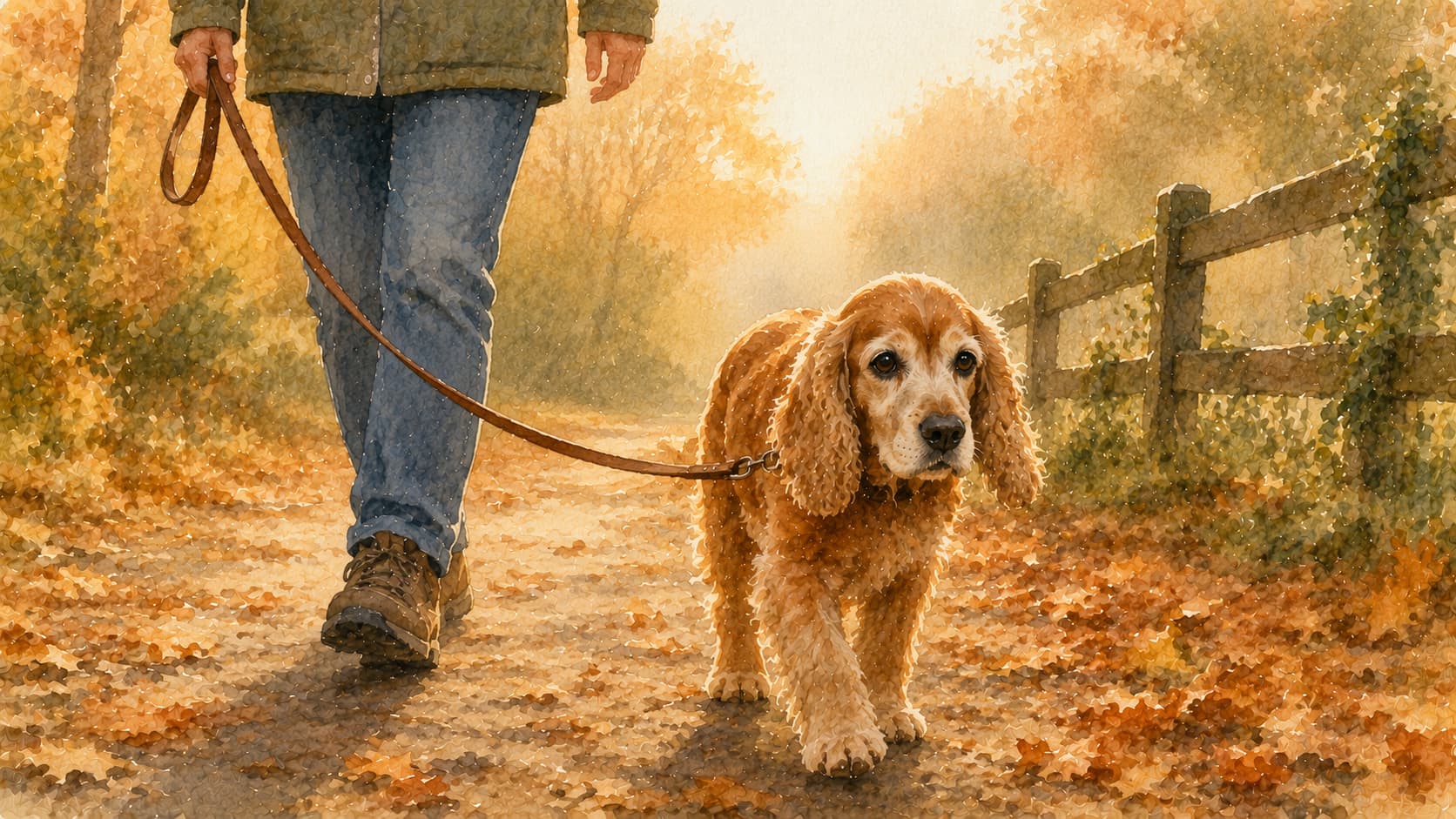
4. The evening walk. Shorter than morning, more sensory than aerobic. A sniff-heavy walk after dinner serves two roles: it helps digestion settle, and it acts as a transition signal — "we're heading toward winding down." Same loop, again.
5. The wind-down sequence. The two hours before bed matter more than any other window. Dim household lighting from around 4 PM. Reduce ambient sound from 7 PM. Offer a long-duration chew around 8 PM. Settle near you (not on you) by 9 PM. The exact times matter less than the order.
These five anchors, run in the same sequence every day, give an aging brain almost all the structure it needs. Everything else is supplementary.
What "predictable, not precise" means in practice
Here's what we mean when we say rhythm over schedule.
Your morning walk can happen at 7:15 one day, 8:00 the next, 7:45 the day after — that's fine. What can't happen is the morning walk being at 7:00 on Tuesday, replaced by a quick five-minute toilet break on Wednesday because you overslept, then back to a long walk on Thursday because you have time. That variability is what destabilises an aging brain.
The principle: same shape, flexible timing. The shape of the day stays consistent. The exact minute on the clock is allowed to drift by 30–60 minutes without disrupting anything.
This is also why we recommend anchors over schedules. An anchor is a reliable event that follows a reliable sequence. A schedule is a precise time table. Senior dogs respond beautifully to the first and struggle with the second.
Free 2-minute DISHAA assessment
See where your dog stands across the six dimensions vets use to track cognitive change. Enter your email — we'll send your assessment and a 3-night calm plan.
Free · 2 minutes · no account · unsubscribe anytime.
How to build the routine without overwhelming yourself
If your dog is already showing signs of senior change and your current routine is inconsistent, don't try to introduce all five anchors at once. The transition itself can be destabilising.
The approach we recommend: one anchor per week, for five weeks.
Week 1: the wake-up sequence. Same order every morning. Don't add anything else.
Week 2: the morning walk. Add the consistent loop and rough morning timing. Keep the wake-up sequence.
Week 3: the two mealtimes. Move dinner earlier if it's currently late. Settle into consistent breakfast and dinner windows.
Week 4: the evening walk. Add the post-dinner sniff loop. Keep everything else.
Week 5: the wind-down sequence. Layer in the lighting step-down, sound reduction, evening chew. By this point your dog's day has five anchors running in order.
This is also the first month of the Hearthside Method — the structured eight-week framework adds the layers most senior dogs need beyond these foundational five: DISHAA observation worksheets, sundowning-aware evening structure, mobility-aware morning rituals, cognitive engagement built for aging brains, weekly quality-of-life check-ins. If you want the full structured version with printable trackers, that's where to start.
Want to know which DISHAA domains need most support? Our free 12-question quiz takes two minutes and scores cognitive change across all six domains. Plus a 3-night calm plan in your inbox. Take the free quiz →
Adjustments for specific senior issues
The five anchors are the foundation. Some senior dogs need adjustments layered on top.
For dogs with significant mobility issues: shorten the walks, but keep their sequence. A five-minute leg-stretching walk in the same loop is more valuable than a thirty-minute walk that skips two days a week. Consistency over duration.
For dogs with sundowning patterns: make the wind-down sequence more elaborate. Earlier light step-down (3:30 PM instead of 4). Quieter household by 6:30. Earlier last walk. The dusk-to-bedtime window is where these dogs need the most environmental support.
For dogs with significant cognitive change: keep the daytime input gentle but real. Two or three short engagement periods (a sniff walk, scatter-fed treats, a slow chew) prevent the dog from sleeping all day and being restless all night. The activity doesn't need to be long; it needs to exist.
For dogs newly arrived in a senior household or recently moved: hold the routine even more strictly for the first 2–3 months. Senior dogs adapt to new environments slower than younger dogs. The routine itself becomes a stabilising force.
What to track to know if it's working
Two weeks after you've layered in the full set of five anchors, you should see:
- More predictable evening settling
- Fewer scattered short naps replaced by more consolidated rest periods
- A more recognisable "shape" to your dog's day, observable from across the room
- (For dogs with sundowning) reduced evening agitation
If you're not seeing improvement after 3–4 weeks of consistent routine, that's information. It often means another domain needs attention — pain, sensory loss, cognitive change beyond what routine alone can address, or environmental factors specific to your home. The free DISHAA quiz gives you a structured way to read which domain is the loudest.
When to involve your vet
Daily routine is home work, not medical work. But there are scenarios where the routine alone won't be enough.
- If your dog seems uncomfortable during the walks (limping, sitting down, reluctance), bring it to your vet — pain is often under-recognised
- If sleep remains highly disrupted after 3–4 weeks of consistent evening sequence, mention it to your vet — there may be another factor at play
- If your dog seems disoriented during normally predictable parts of the day (confused at the food bowl, hesitant at familiar doors), that's worth a cognitive assessment conversation
Bring observations. Three weeks of how the routine is landing — what's working, what isn't — gives your vet far more to work with than a vague "we tried to be more consistent."
Senior dogs do beautifully on predictability. Not perfection. Just rhythm, repeated.
Frequently asked questions
Common questions dog owners ask about this. We answer plainly and stay in our lane.
How important is routine for senior dogs?+
Significantly more important than it was when they were younger. The aging brain has less cognitive headroom to absorb variability — what was a minor schedule change at age 4 becomes a destabilising disruption at age 12. Predictable environmental cues do more of the work as the brain's own scheduling signals get noisier with age.
What is the best daily routine for an old dog?+
Five reliable anchors in a consistent order: a wake-up sequence, a morning walk on a consistent loop, two predictable mealtimes (dinner by 5:30–6 PM), an evening sniff walk, and a wind-down sequence in the two hours before bed. The exact times can flex by 30–60 minutes; the sequence shouldn't.
Should I follow a strict schedule with my senior dog?+
No — rhythm over schedule. A senior dog responds to predictable sequences more than precise clock times. Same shape of the day, flexible timing within an hour or so. Strict schedules tend to fail when real life gets in the way, and the inconsistency that follows is more disruptive than a slightly flexible rhythm would have been.
How do I build a routine for an aging dog without overwhelming them?+
Introduce one anchor per week for five weeks. Week 1: wake-up sequence. Week 2: morning walk on a consistent loop. Week 3: two consistent mealtimes. Week 4: evening walk. Week 5: wind-down sequence. This gradual layering is also the first month of the Hearthside Method's eight-week structure.
Why does my senior dog seem confused when our routine changes?+
Aging brains rely more on environmental cues to know what comes next. When the routine shifts, the cues misfire, and confusion is the result. This is also why senior dogs adapting to a new household, a move, or even a holiday schedule often need 2–3 months of strict routine to fully settle.
What if I can't be home for every part of the routine?+
The anchors don't all need to involve you directly. What matters is consistency — the same sequence happens at roughly the same windows. If a dog walker handles the midday window, keep the same walker and same loop. If someone else handles the morning, keep their sequence consistent too. The dog's brain is responding to the rhythm of the environment, not specifically to you.
Sources
Authoritative references underlying this guide. Linked for verification.
- Cognitive Dysfunction SyndromeCornell University Riney Canine Health Center
- Managing Cognitive Dysfunction and Behavioral Anxiety (2023 Senior Care Guidelines)American Animal Hospital Association
- Updates on Cognitive Dysfunction Syndrome (Jan/Feb 2025)Today's Veterinary Practice


Sara reviews the veterinary literature behind Hearthside's content and ensures every claim links back to a citable source. Her focus areas: the DISHAA framework, sundowning patterns, and sleep–wake dysregulation in aging dogs.
Free 2-minute DISHAA assessment
See where your dog stands across the six dimensions vets use to track cognitive change. Enter your email — we'll send your assessment and a 3-night calm plan.
Free · 2 minutes · no account · unsubscribe anytime.
The 8-week Hearthside Method
A structured plan for the dog you've loved your whole life.
Discover the Method